Saturday, October 19, 2013

My tryst with co-writers

My tryst with co-writers started long time back, very unexpectedly. It was just a few days before the higher secondary exams. Lately, my problem with writing had aggravated significantly. I'd noticed it for the time first time, perhaps, few years ago, before the secondary exams, when I realized that my pen would suddenly stop moving, how much ever pressure I exerted with my fingers. Later I learned that this is something called writers's cramp, a rare neurological disorder, which can't be cured easily. Certain muscles in our body can suddenly get fatigued and restrict certain actions. In my case, the action was writing. Unknown to myself, I'd given the secondary exams with writer's cramp and continued for two more years. But suddenly, just before the higher secondary exams, I realized that I was no longer able to write even a single line, effortlessly, forget writing a full paper for three hours.

Providence had been always providential to me. She'd always appeared before me at the right time, with the right solution, whenever I had a problem. This time too she appeared in front of me and flashed the solution in a wink of hers. There were a few visually challenged students in our college and they gave all the exams with the help of writers - they dictated the answers and the writers wrote on behalf of them. I went to the principal and requested him to arrange for a writer for me. A whimsical one, the principal took time to appreciate my problem. 'You've to get approval from Vikash Bhavan,' he said, asking me to go to the administrative office of the Ministry of Higher Secondary Education in Salt Lake. My mother and I went there the very next day and met the right person. The officer expected someone with no or broken hand, but was surprised to see me with everything visible in right order and number. 'You're not handicapped!' he exclaimed. The mention of the word handicap reminded me of the seats in buses and trams, reserved for physically challenged people. Was he concerned that I sat in those seats? 'Sir,' I said, 'I've writer's cramp and I can't write.'
'Why can't you write?' he asked, staring irritably at my unbroken and intact limbs.
'Sir, I've writer's cramp,' I repeated. 'The muscles on my hand get fatigued...'
'Okay,' he interrupted, and passed a white paper to me. 'Write an application,' he asked. I knew it was my test. I wrote a few lines in English, stopping at each word, and dragging the pen to the next word, as if I was lifting a heavy weight and dragging it along a rough road. I passed the test - I could prove that I was handicapped.

Next a writer was assigned to me - a stout guy, a year junior to me, who had acted, I recalled, in the role of a fat and funny villain in a mythological drama in school few years ago. The language papers went well, with me dictating the answers to my writer. The problem happened with the maths paper. While I was thinking how exactly I would 'dictate' mathematics to someone, I didn't realize that my writer had already fallen asleep. I turned back as his snores were loud enough to shake me off my contemplation. I jerked him and he sat straight, with an apologetic look. 'I'd to see a movie last night,' he said excitedly, 'and I returned to the hostel quite late. I couldn't sleep much...' He was a big fan, he said, of Ranjit Mallik, an aging Bengali actor whose latest action flick - a genre funnily interesting in Bengali films - had been released the previous Friday. I asked him to wash his face. By the time he returned, I'd already started answering the maths paper myself, struggling to write the numbers and Greek alphabets slowly. Luckily, I realized, I could somehow write the numbers, with some effort.

So, from being a writer, he became a co-writer.

Years later, I'd just completed my first book, The Ekkos Clan, and was working on my second book. I no longer needed to write with pen. Typing into a laptop luckily didn't fall under the jurisdiction of the muscles which would get fatigued in the past. So it was not an issue for me to become a writer, despite the writer's cramp. The Ekkos Clan is a fast paced mystery novel, where there was not much scope for writing about romance, love, passion, sentiments etc. It was based on lots of facts and the events happening one after another, without much break or respite either to the characters or the readers. It was like the jhala, the final movement of an Indian raga recital, where a plethora of notes are played very fast, not giving any time to any note to settle down, or linger languidly. On the contrary my second book was a romantic one where languidly lingering is the key aspect of writing. Love needs time to grow. It needs leisurely moments to appreciate the beauty, feel the passion and swim in the graceful thoughts. If there's no time, no leisure, there can't be love. It's like these lines from Ghalib I'd used in The Ekkos Clan

Fursat-e kar-o-bar-e shauq kise, zauq-e nazzarah-e jamal kahan?
Dil to dil woh dimag bhi na raha, shor-e sauda-e khatt-o-khal kahan?
Thi woh ik shakhs ke tasabbur se, ab woh ranai-e khayal kahan?

Leisure for the workings of passion, who has it? An appreciation for the glance of beauty, where is it?
Not to speak of the heart, even that mind didn’t last, the tumult of the madness of a mole, where is it?
Was in the imagination of someone, but now, that gracefulness of thought, where is it?

Love is all about fursat-e kar-o-bar-e shauq, the leisure for the workings of passion, shor-e sauda-e khatt-o-khal, the uproar of the madness over a small mole on the cheek of a woman. It's like the alaap, the first movement of an Indian raga, where there's no haste of rhythm, no bondage of meters, no laya, speed. Each note is played leisurely and allowed to settle into the depths of the senses. Each note is given enough time to gracefully float around. Each and every minute aspect of the sound is allowed to grow and create a magnificent ambiance. That's when the laya and chhanda, the tempo and the meter, the various forms of garnishing and ornamentation make sense to the listener. And this is where I realized I would falter. My style is like the jhala and what I need is the alaap, which is perhaps beyond my capabilities to create.

That was when I felt I could get a co-writer who would create the alaap for me. I tried to figure out how many such collaborations are there in Indian fiction writing. To my surprise, I realized that there are not many fictions co-authored by two people. But I found it very logical. If collaboration works in corporate houses, why can't the same work in writing? After all, a novel is also a product, like a phone or a tablet, which need diverse skills to create complimentary features all of which add up to the satisfaction of the users. The skill needed to design the attractive casing of an iPhone and that needed to create the touch screen are totally different. Both the skills need creativity and the end product, the iPhone, needs to be a perfect solution with the various solutes seamlessly disappearing in the solvent. How's that different from a novel with complimentary writing elements merged seamlessly into the plot and narration? I would provide the jhala and my co-writer the alaap.

So I started looking for a partner, someone with whom I could collaborate. But how do I go about? I registered into various literary groups in Facebook and tracked each post. Almost all appeared to be too intellectual, most of which I didn't even understand. Suddenly one day I bumped on a post, a very simple one, and I had a feeling this was what I wanted. The post was by a lady, whose name told she's a Bengali. I went to her FB page and read a few other posts. I figured she has the habit of writing something every few days and posting it on her wall. More I read more I realized I needed her to co-write my second book. That leisure, fursat-e-karobar-shauq, that attention to the small things like the tiny black mole on the cheek, that languid playing of the notes of an alaap - she has everything.

I sent her a message requesting her to read my newly released book The Ekkos Clan. 'I only read canonical books,' she said very bluntly. I understood I write non-canonical books. I didn't lose hope. I sent her a friend request. I started communicating with her and in a few days I finally divulged my intention. I believe she was more shocked than surprised with such a proposal. Out of courtesy, I believe, she agreed to check the first draft of my second book. I sent her the PDF. Very soon she said I write quite bad. 'It's cliched,' she said. Still I didn't give up. I kept on communicating with her, discussing about our common admiration for Tagore songs and music in general. But very soon a misunderstanding happened and she blocked me.

So that's what I would say a "writer's block", a nightmare to any writer!

My tryst with co-writers continues.

Friday, October 18, 2013

Lokkhi & Alokkhi

Today is Lakshmi (Lokkhi) Puja, celebrated mainly in Eastern India. "I am proudly an alokhhi", someone said in the morning. "alokkhi" is the antithesis of lokkhi, the symbol of wealth. Conventionally alokkhi is loosely used in reference to anything that's bad. It's an expression of bad luck, a euphemism for loss or lack of wealth, a bad omen. Bengali uses alokkhi as an epithet for a bad girl or a bad thought. So when I heard someone saying, "I'm proudly an alokkhi", it made me think.

The first thing I did was check for the etymology of lakshmi, the Sanskrit word, of which lokkhi is the Bengali pronunciation. I refered to the Monier Williams' Sanskrit dictionary. It says the following:

लक्ष्मी f. (cf. लक्ष्मीक) a mark , sign , token
 (with or without पाप्/ई) a bad sign , impending misfortune
 (but in the older language more usually with प्/उण्या) a good sign , good fortune , prosperity , success , happiness (also pl.)

So basically lakshmi means a mark, sign, token, which can be both good and bad. Though Monier Williams doesn't give the origin or the root of lakshmi, but mark, sign etc implies it perhaps comes from the root laksh, akin to Latin locus, meaning direction, aim, mark, sign in Sanskrit.

So this is again an interesting aspect in the evolution of languages and words - the same word meaning both good and bad.

Divine and devil both are akin to Sanskrit deva.

Asura is both god and demon. Ahura (asura) Mazda is the supreme God in Zoroastrianism. Even in Rig Veda, Varuna, one of the oldest members of the Indo-European pantheon, akin to Uranus, is sometimes referred to as the King of Asuras, against Indra, the King of Devas.

Lakshmi too means both good and bad. So lokkhi and olokkhi are both lokkhi!

Good and bad are often just two perspectives which can change totally depending on the prism through which you see. A classic example is the case of a terrorist, say a separatist, who's selflessly fighting for, say, liberation of Kashmir. For rest of India she is a terrorist, but for the people of Kashmir she is a patriot, and if she dies fighting for the cause, she would become a shaheed. Bhagat Singh is a shaheed for us, but was a terrorist to the British government.

A conventional thought, that's generally steeped into our society, often has lots of good and bad predefined, mostly without much of logic. This is good and that is bad, this is lokkhi and that is alokkhi, we often hear people saying. Whenever someone says, ki lokkhi meye, what a lokkhi or good girl, you know that the girl in question surely is a virgin, doesn't drink, doesn't go to parties, very likely sits in the first bench in the class, wears a particular type of attire where the visibility of cleavage is out of question, probably would go for an arranged marriage, and may do all compromises in life, for her parents, husband and kids. None of the parameters that would generally make a Bengali girl lokkhi has anything to do with good or bad, but still a certain type of girl is lokkhi. To refer to a particular type of good boy, we don't even bother to apply the feminine adjective lokkhi to a male - ki lokkhi chhele, what a good boy!

A girl with a typical round face without any sharp feature is often called lokkhi-shree, which may translate to good looking in English, replacing lokkhi with good. There's absolutely no reason why just a particular type of face is good. Still, we so often use these terms so casually, that we don't even think what we're saying.

Likewise we also use alokkhi, or lokkhi-chhara, deprived of lokkhi, to denote the antithesis of lokkhi, mostly without much logic.

Lokkhi and alokkhi in colloquial Bengali usage, like many such words depicting good and bad, are symbols of prejudice, orthodoxy and regressive attitude.

I feel the reason behind the evolution of the opposite dual meanings of the same word - lakshmi in this case, which means both good and bad - is perhaps to create a linguistic conscience, which would point fingers to the futility of profiling something as good and something else as bad. It actually says, what's lokkhi is also alokkhi and what's alokkhi is also lokkhi.

Coming back to the comment, "I'm proudly an alokkhi," I feel, perhaps it's her way of saying, "I'm what I am; I don't care what you call me by - lokkhi or alokkhi, I give a damn."

Technically she is correct, both do mean the same!!


Nationalism vs. Fanaticism: Discussion @ Oxford, 9 October, 2013


The newly opened Oxford book store in Connaught Place in Delhi organized a discussion around my book The Ekkos Clan on 9th October. Omair Ahmed, the acclaimed author of the book Jimmy the Terrorist had agreed to be in the panel. Shrey Goyal, the Editor-in-Chief of Mensa was in conversation with me and Omair. Though the attendance was not that great, 9th being a weekday, the discussion was one of the best I've had in any such event. After the customary introduction about my book and the motivation to choose such a topic - ancient Indian history - the discussion moved towards very serious topics.

A strong underlying theme of The Ekkos Clan is actually the futility of racial supremacy. It talks about Nazism, as an outcome of the belief in the supremacy of the Aryan race. The Germans manipulated history to claim that they were the true progenitor of the Aryan race - the term Aryan was wrongly used to actually refer to the ancient Indo-European peoples whose original language is believed to be the mother of Sanskrit, Greek, Persian, Latin, German, English, Spanish, Portuguese, Hindi-Urdu, Bengali and many other major languages of the world. The idea behind the claim of being the true progenitor of the Indo-European peoples is indirectly claiming that the Germans are in fact the forefathers of the great civilizations in Greece, Rome, Persia and India, and hence a superior race whose progeny comprise almost half the world. This feeling of superiority metamorphosed into Nazism, which was perhaps one of the worst forms of cultural or racial fanaticism.

Now the question arises, is this feeling of superiority always a vice? Nationalism, someone in the audience pointed out, is fueled by a sense of superiority. Unless I feel proud of my country, my culture, my language, unless I have a feeling that my culture is a superior one, I won't feel the fervor of patriotism, the fire of nationalism within me. Very logically the cultural renaissance that happened during the Indian Independence Movement was a major force behind instilling patriotism into the minds of millions of Indians subjugated by the British rule for centuries. The self esteem of the Indians was at its nadir, thanks to the centuries of humiliation and the well crafted propaganda by the British machinery against anything Indian.

"Charles Grant remarked that a man of real integrity in Bengal was an unusual phenomenon. James Mill wrote a pathetic book, The History of British India, ridiculing Indian culture, history, religions and languages and it was made mandatory for the East India Company officials to read that nonsene before they came to India. Alexander Duff founded a good institution like the Scottish Church College but was very vocal about his dislike for Indians and Indian culture. He ranted that Indians had no liberty, will and conscience of their own. Macaulay wanted to introduce English education in India because he felt that all the Arabic and Sanskrit literature of any value could fit on a single shelf. Isaac Taylor’s The Origin of the Aryans and W. W. Hunter’s The Annals of Rural Bengal were replete with ridiculous assertions about the inferiority of the Indian race and culture."

Under this circumstance, the first and foremost thing needed to inspire the Indians was to make them feel superior. That's where the cultural renaissance played a great role, without which it was impossible to arouse a subjugated nation, unite a fragmented nation. Lot of people wrote about the history and heritage of our country. The idea of looking back was actually to remind the Indians about her glorious past and feel superior.

But then, the same feeling of superiority was also at play behind Nazism. So where is the line between the sense of superiority that instills nationalism and that gives rise to Nazism? I don't think there's a proper line. It's a very thin line that separates nationalism from fanaticism. The Germans were no doubt patriotic. So were the Indians who fought for freedom, strongly feeling that a great nation like India couldn't be but free. But then what differentiated the Germans from the Indians. Perhaps, the Indians were proud of their culture and believed that they belonged to a superior civilization, but they were not envious of an equally superior civilization in their vicinity - that of the Persians.

At this point Omair brought in a very interesting perspective. He said that superiority, when becomes an absolute thought or feeling, leads to decline. What's now superior may not be superior forever, and the moment one realizes this thought, she would always strive to be superior. But when one believes that her superiority is an absolute truth, she stagnates, and that's why, perhaps, both Latin and Sanskrit died, despite having royal patronage. Latin and Sanskrit were no doubt superior languages sometime in the past, but they failed to evolve, grow, because people felt that they were absolute superior languages without any need to grow or evolve.

A very interesting analogy can be drawn from the corporate world. In the recent past Kodak, the company that had invented digital photography and that had been synonymous to photography for hundred years suddenly died. Nokia, which once had 80% market share in mobile phones also died - Microsoft bought them. Blackberry, which had the most secured mailing service for smartphones, is also at the verge of death. In all these three cases, the companies were superior at some point of time, but still died, because, perhaps, they failed to maintain their superiority, which is not an absolute thing. Once superior, doesn't mean always superior.

Now coming back to fanaticism I pointed out the case of linguistic fanaticism rampant in various forms throughout India. Major literary big shots were on roads in Bangalore, few years back, to demand classical language tag for Kannada, as Tamil and Telugu were already classical languages. The people who were fighting for a 'classical language' tag for Kannada, did feel that their language was superior, but at the same time they were envious about Tamil and Telugu. Bengali, my mother tongue, is one of the youngest languages and it's far from being tagged ever as a classical language. But do I've any sense of inferiority for this. On the contrary, I feel that Bengali is one of the best languages. My sense of superiority is irrespective of the status of any other language around. I don't care if Tamil is a much older language than Bengali.

People who were demanding the classical language tag for Kannada were border line fanatics, but of course not me.

Thursday, September 19, 2013

An interview: By Sujata Rajpal, on behalf of Star of Mysore


  • You said, “The journey of an author is lonely.” Please elaborate
Lonely because any creative thing is a lonely thing. A music composer can't share his or her excitement or frustration or pain with anyone else. The awe of creating a melody, or the frustration of not being able to create one, both can't be shared. Similarly, writing is also a lonely thing. You have to take out time from your daily chores, sit at the corner of a table day after day, sacrificing family-time, compromising your social life, always looked upon as being selfish by your family. Even your spouse may not understand why you're getting aloof from everyone and spending so much time on writing. So you're actually left behind by everyone, your family too...
Then once the writing is completed, the lonely process of getting a publisher and then running around promoting your book, all alone. No one would have the time and passion to go with you, run with you.

  • Are you writing your next book? If yes, what it is about? Will the next one be also based on history and a thriller?
Yes, I've already completed the first draft of my second book, which is not a sequel of The Ekkos Clan. But I do have a plan to make a trilogy with Afsar-Kratu-Tista and linguistic palaeontology, of which The Ekkos Clan is the first book. I even have the rough story line for the 2nd book in this trilogy in my mind, but it will take some time to come. May be, it will be my third book.

My yearning to make Kharagpur, or KGP, as it's better known as, the small place where I studied engineering, a part of my literary creation is so strong that I want to write a KGP trilogy too, a set of three unusual love stories, all originating in KGP. My second book, about which I've just mentioned,  would be the first book of this KGP trilogy. I’ve named it Prembajar.  I even have the plot ideas for the second and third books in the KGP trilogy, KGP to me is like a miniature world, everything compressed and contracted within the confines of the walls that enclose the campus. The engineering aspect is just like a passing thought, nothing that can profile this fabulous place into. My attempt in writing the KGP trilogy is just a humble effort to talk about this world, of which, it was my privilege to be a part.

  • You said , you took four years to finish your book, did you write every day as a practice or wrote whenever the flow of thoughts allowed?
Actually the entire project took more than 5 years to complete, starting from June 2008 till now. I didn't write everyday, but I tried to spend some time everyday for my book. The main part of writing the book was the research work, which took a big part of these 5 years.

  • What do you do when you get writer’s block?
I think every word I write seems to be inhibited by some sort of writer's block. Not a single line or word flowed out fluently, as I tend to believe it might, for a gifted writer.

  • How often do you come to Mysore and what do you like the most about Mysore ?
Mysore is on the way to most places we visit from Bangalore - Coorg, Ooty, Kerala, etc. We go to Mysore almost twice or thrice a year. Every time we're passing by Mysore we try to spend a night in the Brindavan Gardens. Till few years ago they used to allow people walking on the dam. That was one of the most amazing things. 

  • These days, many small vanity publishers are mushrooming and the market is full of books in below average English. Do you think such publishers are spoiling the literary scene? 
I don't think anything can spoil the literary scene. Literature can't be spoiled, can't be glorified too. It has its own life cycle, own evolution process. If the below average English works are selling more, and if those are what people are liking, then that's literature. Fifty Shades of Grey would be called soft porn even few years back. But now it's displayed respectfully in all book stores. People are liking the book. It won't be right to say that it's spoiling the literary scene. I may not like it, you may not like it, but there are others who are liking it. Good and bad should always coexist. Tagore, in his last novel, which incidentally he started writing in Bangalore just few years before his death, says that if there's too much of good, the good becomes mediocre. So you need to have the bad things too, to make the good look better.

The Ekkos Clan - The KGP connection

“The Ekkos Clan” is my first novel. It’s a mystery novel, set against the backdrop of ancient Indian history. I’ve been an avid fan of Indiana Jones since long. Perhaps the first Indi adventure I saw was The Last Crusade, shown in Netaji. Amidst the uproar of Tarapada, Sean Connery emerged suddenly, giving a grown up Indiana Jones some important fundaes about how to handle girls. Indi, of course, didn’t listen to his father and the outcome was disastrous. Since then I’ve seen all the Indiana Jones movies and I was always intrigued how some controversial aspects of Christianity were so well used to create a thriller. Later came Robert Langdon and I was again intrigued. Perhaps that was the seed thought behind my book. I felt the ancient Indian history has loads of things that are so old and mysterious that neither they can be proved nor disproved. Many things are just left to interpretations and that’s what makes them  ideal for authors like me, who want to use them in a fiction.

It’s a contemporary mystery, which begins in the 90s when Kratu suddenly discovers that his grandmother’s bed-time tales are actually not mere fables or stories, that each of them is like a riddle that’s connected to the many thousand years old history of our country and civilization. At the same time he also finds out that all the unnatural deaths that have raked their family for the past hundred years are actually murders – some fanatic group has been constantly trying to kill his family, rather the stories in their family, which if come out, may change the way the origin of our civilization and culture is generally looked at.

I wanted to set the novel partially in KGP. All my protagonists are young and identifying them with KGP, and more with the four years I’ve spent there, would have made my life simpler, as I wouldn’t have to imagine many things. But then, lately there have been lot of IIT stories and I didn’t want to be perceived as another IITian turned author writing on IIT. But anyone who reads my book would get the flavour of KGP in many characters. It’s so easy for me to create a life that’s full of fun and frolic, but still rooted in traditions, customs, because that’s what the KGP life was, and I’m sure, is now too.


My yearning to make KGP a part of my book is so strong that I’ve already planned to write a KGP trilogy, a set of three unusual love stories, all originating in KGP. I’ve already completed an initial draft of the first book of this trilogy. I’ve named it Prembajar. This one would be my second novel. I even have the plot ideas for the second and third books in the KGP trilogy, though they make take some time to write. KGP to me is like a miniature world, everything compressed and contracted within the confines of the walls that enclose the campus. The engineering aspect is just like a passing thought, nothing that can profile this fabulous place into. My attempt in writing the KGP trilogy is just a humble effort to talk about this world, of which, it was my privilege to be a part.

Saturday, September 14, 2013

The Ekkos Clan: All Reviews

A promising debut in the growing realm of modern Indian fictionJug Suraiya

"For a novel whose setting stretches from the Partition-affected villages of Noakhali, Bngladesh to Arkaim in the Southern Urals , The Ekkos Clan is a daring novel. The scope of the narrative is magnanimous and deftly handled. But perhaps where the book falls short is the way that it is written. Though a racy and gripping read, there are rarely any flashes of literary brilliance, when it comes to the descriptive and the introspective. Involving elements of ancient history, mathematics, music, orality and linguistics, author Sudipto Das has weaved a cinematic tale of migration, revenge, and how the everyday preserves history in unique ways, unceremoniously occupying our locale. The narrative spins around the stories which Krotus, the protagonist, grandmother Kubha used to tell. Two successive deaths in his family kicks start a chain of events and discoveries which transforms the innocent childhood tales into caskets of hidden secrets. The Ekkos Clan should be read for its sheer aspiration and the intelligent handling of historical material."  The Sunday Guardian

"The book is primarily the story of two generations: a strong, but realistically flawed, woman facing enormous social upheavals, and the "coming of age" of her grandson in the modern world, harshly affected by events that connect the two lives. But, there is a curious difference in how the two are portrayed: The first of these characters is protrayed with a deep empathy, but at an instant in time, devoid of the flow that surely gave rise to her; she is more a legend than a character, a narrative counterpoint in a dramatization invoked to give substance to unreal times.  The second, by contrast is pure flow: fleeting, changing, and never with substance enough for us to get to know him. He too, then, is a narrative device, a "first person" presence that lets us into the events, an anchor for long winding discussions that provide the reader with enough scientific background to follow an interesting side line that the author seems to want the author to concentrate on, though its connection to the central events in the lives of either is rather distant.

But leaving aside this question of coherence and of the long interludes whose scholarly style clashes strongly with the light pace of novel, and leaving aside the undeveloped character of the narrator that makes the reader feel sophomorish voyeur in the matter of his loves, the bulk of the book is an adventure story uncovering events four thousand years back in history.  The scholarship is excellent, and one gets the feeling that the events could all be real.  There is an enjoyable air of the mystic about it which makes it a good read; but at the end, something is lacking in the telling.  The main story ends too soon when the current events are all clear, and the sojourn to the past feels like a protrusion designed to explain minor parts of the narrative, the stories in it that could not have been introduced before would better have been left to the imagination.

I guess what I am complaining about is the clash between the serious beginning, the off-putting humor, and the lack of a climax.  But, then it is the authors vision, not mine, and I must admit I lost little having spent a few pleasant evenings with it
." Tanmoy Bhattacharya

"I too grew up with stories of Noakhali. My grandmother belonged to the Roy Choudhurys' of Karpara, Noakhali. She of course, escaped the carnage, as by then, she had relocated to Calcutta post her marriage a few months before the incident. However, she lost her brothers and uncles and her family who happened to be at the desher bari that fateful week. The men of the family, were beheaded, young women taken forcefully by the mob and the mansion locked from outside and burned to ashes with about thirty people still inside both dead and barely alive. This was the same house where both Gandhi and Subash Bose had visited and stayed many times in the past year and my grandmother and her cousins had sang vande mataram in their public meetings. By then, everyone feared that Karpara Roy Choudhurys had been identified as enemy of Pakistan, and they urged them to leave but the grand old man refused to flee his bhite, his desh and forbade his family members to leave. He owned a .303 British riffle and announced he will teach the mindless hate instigators a lesson.


It look my grandmother years to trace a few women who survived. Some were found, years later, in the brothels of Mumbai but refused to be recognized perhaps out of shame and the angst they felt at their fate. My grandmother's parents fled at night, with just the clothes on their back and was helped by a muslim servant, in whose hut they were hiding for three days. They said, the house was still burning when they left on the third day. It took them many risky boat rides at night, covered up in burkhas, to reach Calcutta after a week.

So it was all too real for me to relive the stories I have heard all through my childhood - of the Bangla that was our home and the Bangla where we lost everything. In the later years, I am witness to the many scars the family bore from the uthbastu days of losing their loved ones and their bhite mati to insane violence. My great-grandfather, lost his mind slowly over the years, suffering from the trauma of what he had witnessed back in Karpara and perhaps from the guilt of having survived. His last days were spent in delusional phone calls to Gandhi, begging for help to quell the Noakhali riots and to restore peace. In his stories, despite the urgent messages reaching Congress supreme leadership in Kolkata, the much needed help never arrived. And when it did, it was already too late. Apparently, someone high up, delayed the decision for political gains. In his stories, the instigators of the violence and atrocity, were not local Bengali muslims. He said, the perpetrators rode horses and looked distinctly like the Pathans from Bihar, and they did not speak nor understood bangla. This he knew, because being a practising lawyer, well wishers asked him to form a negotiation team that proposed talks with the instigators but their offer was never accepted. I have vivid memories of what then seemed to be horrific tales told by a mentally unhinged old man. Among his stories were also the stories of the life that was. The innumerable festivals they celebrated, the rivers that were at once fearsome and bountiful, the green fields of paddy and the many many songs. I grew up thinking this was a mythical land where everything was touched by gold! That spell did not last long. And for years I wondered in anger about the injustice and political apathy. I wondered why no one told this tale of, what many believed to be, engineered violence to show Jinnah in bad light among the world opinion makers. 

I am sure, most of the families from East Bengal, who fled from their homes and migrated, have similar stories to share. So thank you for telling this story and choosing this as the backdrop to your mystery. I rambled for a long while." Piya De Bose

Review in Flipkart

Review by Ranga

The Ekkos Clan: Review by Ranga

Reproduced from http://rangarajaniyengar.wordpress.com/2013/09/09/book-review-the-ekkos-clan-debut-novel-by-sudipto-das/

Imagine a necklace with a hundred pearls. If these pearls are numbered from 1 to 100, it would be easier to identify them and arrange them in a particular sequence, right?  If these pearls are scattered in an open room with little or furniture, it will be relatively easy to get the pearls and string them together. If you were however in a room with several furniture items, it will be difficult for you to search for the pearls in the nooks and crevices under the sofas, between the cushions etc. The challenge will get amplified with increase in the size of the room and number of items present in the room.
I know it was never going to be easy making an attempt to review Sudipto’s book, but what I intended to convey was that the book is extremely complex and hats off to Sudipto for delicately stringing together this beautiful string of pearls from 1 to 100 by undertaking years of painstaking research and taking us on trips across the globe which is akin to finding each pearl from under the bed or some such difficult corner of an overcrowded palatial house.
The book starts off impressively in Bangladesh and sets a very high expectation. I was forced to wonder if he will manage to sustain that level of excitement in the book. He almost does and that is where my respect for the author has gone up significantly! To Sudipto’s credit, he has weaved together a story with its multiple characters, linked several stories, several historical facts, subjects like astronomy, music, Rig Veda etc and anything more will be a spoiler for you.
I must admit that when I bought the book, I did so thinking that as an aspiring author myself, it is only fair to encourage a fellow IIT-ian. But I am happy I read this book because he surpassed my expectations by miles on several counts. I do not know how he managed to research so much and on topics that have nothing to do with Engineering. Ok, that is acceptable but linguistic palaeontology with discussions around cognates and lots of musical gyan thrown in was surely not what I would have predicted ever. I am yet to get over the hangover of The Ekkos Clan! The book has all ingredients of being made into a high octane thriller of a movie. Krotu Sen with all the women around him go in search of unravelling the mysteries behind the stories he has heard as a kid. Having been in Calcutta earlier, I could relate to all the Bengali terms but even if you don’t know the language, the book can be enjoyed thoroughly. The descriptions of places, emotions etc were enjoyable but one area of improvement is the dialogues. When Krotu and Afsar or Tista (well, Tits!) engage in conversations, the tautness in the flow gets diluted at several places. This is one area of improvement as per my analysis. Interestingly, Sudipto talks about his grandmother’s stories as an inspiration. The mention of some of my other KGP batch mates in the Acknowledgement section was also a pleasant surprise.
I am not sure how long it will take for him to come out with his next book, but if the quality is going to be similar, I am ready to wait for 4-5 more years! In the meantime, wondering if the rights will be bought by Karan Johar … of Krotu will be played by Ranbir, who will Afsar be? Will they actually show the khistis, censor the gaalis or the crudeness? … We’ll wait, will definitely be worth it!
Overall a score of 3.5 to 4 stars out of 5. Please go ahead and read this book: it is highly recommended!

Sunday, September 8, 2013

Photos & Videos of The Ekkos Clan


The Ekkos Clan: Events


  • 16 August, 2013: The Ekkos Clan made featured book & Sudipto Das featured author at JustBooks
  • 24 August, 2013: Talk at Amaatra Academy, Bangalore

  • 15 September, 2013: Book reading, JustBooks, Kuvempunagar, Mysore
  • 21 September, 2013: Book reading, JustBooks, Vidyaranyapuram, Bangalore
  • 22 September, 2013: Book reading, JustBooks, Banashankari, Bangalore
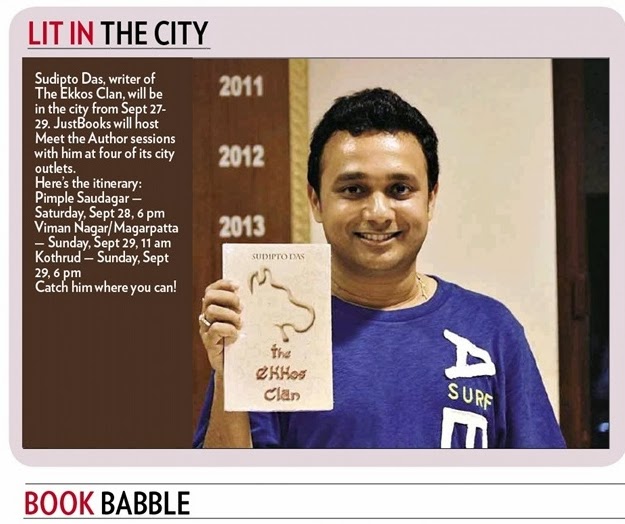
  • 27 Seprember, 2013: "Meet the Author" in Sandvik, Pune
  • 28 September, 2013: Book reading, JustBooks, Pimple Saudagar, Pune
  • 29 September, 2013: Book reading, JustBooks, Viman Nagar, Pune
  • 29 September: 2013: Book reading, JustBooks, Kothrud, Pune
  • 5 October, 2013: Book reading, JustBooks, Panampilly Nagar, Cochin
  • 9 October, 2013: Book reading, Oxford, Connaught Place, Delhi
  • 19 October, 2013: Book reading, JustBooks, Koramangala, Bangalore
  • 20 October, 2013: Book reading, JustBooks, Basaveshwaranagar, Bangalore


  • 9 November, 2013: Book reading @ Just Books, salt Lake City, Calcutta

  • 23 November, 2013: Author's Talk, Amaatra Academy, Bangalore


  • 20 December, 2013: Greet & Meet Sudipto Das on a Mysterious Talk Session on "The Ekkos Clan", Tata Consultancy Services, Bangalore


  • 7 June, 2014: Meet the author, Vermilion House, Bangalore

  • 25 June, 2014: MaathuKathe, Interactive discussion, India Foundation for the Arts, Bangalore

Saturday, September 7, 2013

The Ekkos Clan - In Media

September 26, 2013: The Hindu

Sudipto Das’ debut novel combines ancient history, linguistic palaeontology, mathematics, music and a mystery story 
If you are a history buff and a thriller aficionado, then The Ekkos Clan by Sudipto Das might just be the book for you. Ancient Indian history, linguistic palaeontology, mathematics and interesting insights on music are held together by a gripping mystery in Sudipto’s debut novel. 
The Ekkos Clan (Niyogi Books, Rs. 350) tells the tale of how Kratu, a graduate student at Stanford, his best friend Tista and linguistic palaeontologist Afsar Fareedi, discover that the bedtime stories Kratu’s grandmother Kubha inherited from her ancestors, have hidden within them linguistic fossils and layers of history. This leads the trio on a quest to trace the origin of her stories and in the process they make some fascinating discoveries. 
It took Sudipto intensive research to put the novel together. “I read up on ancient Indian history between 2008 and 2010. 
By July 2010, I thought I would start writing because as Newton said the more you know, the more you realise how little you know. I thought I had to start writing,” says Sudipto who holds an engineering degree from the Indian Institute of Technology, Kharagpur, and is also a member of a music band Kohal. 
The first draft was written in six months. Sudipto then chose a sample of 25 readers, which included his friends, acquaintances and relatives, between the ages of 18 and 60, and gave them the first draft to read for feedback. He also sent in the manuscript to the Literary Consultancy, London. “They are known to be one of the best literary reviewers. They gave me detailed feedback.” The book was released recently at Oxford Bookstore. 
The first two chapters of the novel, which also have an autobiographical element, are set against the 1946 Noakhali Riots. “I thought I had to write about the Partition of Bengal, as not much is written about it. I wanted to write about the survivors of the Noakhali riots. My father and his family came to Kolkata when the riots broke out. My father went onto become an engineer and provided well for his family. There were survivors who made a life for themselves despite being affected by the riots; I wanted to explore such stories in my novel.” 
Sudipto developed an interest in music, history, mathematics and literature as a child. So, combining these aspects in The Ekkos Clan seemed only natural to him. “I knew the right thing about Indian culture. I have closely read Tagore’s works and had studied at the Ramakrishna Mission Institute. I have also always been fascinated by the poetry in the Rig Veda and the historicity of it. There is an inner meaning in the poems that are simple, yet profound. I wanted to demystify the Rig Veda in this book,” says Sudipto. 
Speaking of the relevance of linguistic palaeontology in ancient Indian history, Sudipto says: “Historical proof is very limited in ancient Indian history, but linguistic palaeontology proof is plentiful.”

September 22, 2013: Sakal Times, Pune

September 20, 2013: Bangalore Mirror

A tale of discovery and unraveling mystery. It's the story of grandmother Kubha and her grandson Kratu who belong to one of the traditional clans. Unaware of his grandmother's origins, Kratu goes in search to find the missing link with his two best friends Tista and Afsar across continents and discovers his ancestry. An interesting read for an afternoon.

September 1, 2013: Deccan Herald

The Ekkos Clan, Sudipto Das, Niyogi, 2013, pp 282, 350 
Someone wants Kratu’s whole family dead. Is it personal vendetta or is it because they have access to Kratu’s grandmother Kubha’s stories, which conceal perilous secrets. The eventful lives of Kubha and her family span a hundred years and encompass turbulent phases of Indian history. 

August 23, 2013: iitkgp.org

“The Ekkos Clan”, the debut novel of Sudipto Das (1996/ECE/RK), is already at position 3 in the best sellers list in the Literature and Fiction Section in Flipkart in less than a fortnight. 
“A promising debut in the growing realm of modern Indian fiction”, said Jug Suraiya, a senior columnist with Times of India, about the book. 
Get your copy from Flipkart and country-wide any store of Sapna (Karnataka, & Tamil Nadu only), Oxford & Crossword.
Read online reviews on http://www.flipkart.com/the-ekkos-clan/product-reviews/ITMDMTDCQ5GTGTYM

August 17, 2013: Sunday Guardian

For a novel whose setting stretches from the Partition-affected villages of Noakhali, Bngladesh to Arkaim in the Southern Urals , The Ekkos Clan is a daring novel. The scope of the narrative is magnanimous and deftly handled. But perhaps where the book falls short is the way that it is written. Though a racy and gripping read, there are rarely any flashes of literary brilliance, when it comes to the descriptive and the introspective. Involving elements of ancient history, mathematics, music, orality and linguistics, author Sudipto Das has weaved a cinematic tale of migration, revenge, and how the everyday preserves history in unique ways, unceremoniously occupying our locale. The narrative spins around the stories which Krotus, the protagonist, grandmother Kubha used to tell. Two successive deaths in his family kicks start a chain of events and discoveries which transforms the innocent childhood tales into caskets of hidden secrets. The Ekkos Clan should be read for its sheer aspiration and the intelligent handling of historical material.

August 2, 2013: The Hindu

Legends of India will feature a sarod recital by Ustad Aashish Khan, a performance by music ensemble New Shanti, an Indo jazz group led by Ustad Aashish Khan and a book launch of The Ekkos Clan by Sudipto Das will be held on August 3... 
Sudipto Das’s debut novel The Ekkos Clan is a contemporary thriller.