Friday, May 9, 2014

Praises for The Ekkos Clan

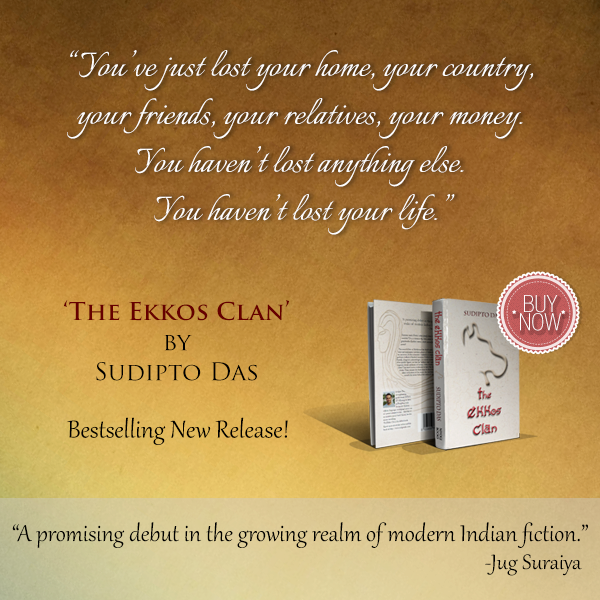
‘A promising debut in the growing realm of modern Indian fiction.’ – Jug Suraiya

‘For a debut novel The Ekkos Clan is quite promising, with echoes of Dan Brown in the storytelling. Kratu Sen, an engineer in Stanford, suddenly realises that the stories he and his sister have grown up listening to — about their grandmother Kubha — are not as simple as they sound. Meeting Afsar, a linguist palaeontologist, encourages Kratu to decode the “chhele bholanor golpo” (tales told to pacify children). He discovers that the names of the characters and places have a striking similarity with the Rig Veda and the Aryans. Could the stories preserved for centuries have a greater significance? …The Ekkos Clan is like any fast-paced thriller, replete with murder and miraculous escapes.’ – The Telegraph

‘If you are a history buff and a thriller aficionado, then The Ekkos Clan by Sudipto Das might just be the book for you. Ancient Indian history, linguistic palaeontology, mathematics and interesting insights on music are held together by a gripping mystery in Sudipto’s debut novel.’ – The Hindu

‘Historical fiction, The Ekkos Clan combines the struggle for survival with Kubha's determination to safeguard her lineage in turbulent times… [It] is a folktale packaged for the contemporary reader.’ –Bangalore Mirror

‘A tale of the Indian civilization and culture, The ekkos Clan written by debutant author Sudipto Das takes you on a roller coaster ride, telling the mystery behind the Aryan race as well as delving into the origin of stories behind mankind’s greatest book, the Rig Veda… The author brings out India’s amalgamation of so many cultures, languages, races... Exploring multiple generations of a family, the book follows a pattern where one gets to read about linguistics, history, archaeology, music, engineering and philosophy moving from chapter to chapter.’ – The New Indian Express

‘For a novel whose setting stretches from the Partition-affected villages of Noakhali, Bngladesh to Arkaim in the Southern Urals, The Ekkos Clan is a daring novel. The scope of the narrative is magnanimous and deftly handled... Involving elements of ancient history, mathematics, music, orality and linguistics, author Sudipto Das has weaved a cinematic tale of migration, revenge, and how the everyday preserves history in unique ways, unceremoniously occupying our locale… The Ekkos Clan should be read for its sheer aspiration and the intelligent handling of historical material.’ – The Sunday Guardian


‘Written by debutant author Sudipto Das, The Ekkos Clan is essentially a mystery novel, but is grounded in a substantial base of research and exploration into our past. This journey was not made with the aid of tangible historical remains and proofs, which diminish once you try to step further after going back a few millennia, but instead, a more living, breathing form of residue from our ancient past is combed through: language…[The] Application of linguistic palaeontology amidst a mystery novel marked with glimpses of mythology and historical narrative is unique in an Indian setting, and places both the author and the novel at a space currently occupied by a very few.’ –Newsyaps

Sunday, February 16, 2014

The Ekkos Clan - An elaborate review by Atanu Neyogi

Atanu, my friend, has been writing to me over the past few days, as and when he has been reading my book too. Though he has promised to post a consolidated review on my wall, I couldn't resist from publishing all his communication in the form of a blog. I'm sure he will edit out few things when he writes the final review, but whatever he has written is worth a read. It's perhaps the most elaborate discussion on my book.

---
Got your novel and started reading. Nice prose, unadorned but precise, letting the strength of narrative carry it along.
This is going to be a bit uncomfortable as the Bangladesh part (evidently based on stories you have heard) resembles too much of what I heard about my own family.
A fallen aristocracy has a sense of poisonous self-pitying perspective of the world which swings between superiority and inferiority complex. I have seen that so much growing up in a clan of displaced, long-suffering but self-entitled Vaidyas over the years I had learnt to treat those childhood stories as an inherited nostalgia for an imagined past. I am guessing your novel is going to make some old scars a bit raw.
Now to read on to Kubha, I am anticipating some deep historical unveiling...
----
Instead of writing one big review at the end, I have thought it would be better if I let you know the minor comments as I read along and then have a summary later. You may or may not find them very useful.
We seem to share some common interest: music, linguistics. I grew up listening to a lot of Western classical, a love that remains with me though nowadays most my my classical listening is focused on post-tonal music: Schoenberg, Berg, Ligeti, Saariaho, Stockhausen... However Jazz is what I listen most and I found your description of Kratu's attempt at mastering non-diatonic chords on guitar at the beginning of the Pur-Bhed chapter to be funnily accurate. However these non-diatonic intervals do appear in a lot of tonal classical music...Debussy, Ravel,... and of course in Bach (who foresees so much of the possibilities). Anyway, some critical comments:
a. You need a better Editor. In Chapter 3 at one place talking about the three-node melodies the text says "Do, Re, Pa" instead of "Do, Re, So" . It was a slip of pen (not uncommon to multi-liguists) from your part that should have been caught in editing.
b. If I may, whereas your writing about Kratu's first meeting with Afsar is impressive and masterful, the Tits chapter was maudlin and unsure at the same time. When you are trying to convey a cluster of complex interconnected feelings, which is rendered more unfathomable to outsiders by a very uniquely local form of inter-family dynamics that colors Kratu and Tista's perception of each other, trying to explain them at get-go is not a good strategy. We, your readers, should feel intrigued and mystified and not over-informed. Also, if I may, the whole "Tits" joke is a little juvenile. It may all be very true and yes funny, but a little on the overwrought side of the humor. The sexual humor can be a very potent weapon in a writer's arsenal, so it is best used sparingly.
c. You are at your best when you are writing about Kubha and her stories, and also writing about things that emanate from those stories or are connected to, even in anticipation. For everything else the quality drops a bit, not significantly but noticeably enough. Something you may want to think about for your next novel.
---
Sudipto, so finally finished the novel. Thought a little bit about the most efficient way to convey my perspectives that you might find on the right side of originality. I am sure the obvious scopes for improvements have already been elucidated by your myriad fans and well-wishers.
First of all, a very very enjoyable read. Using the narrative thrust of a thriller to engage the readers' intellect on the subtler and more erudite core of the story is a time-worn tactic, but it doesn't always work. Yours did. Excellently done. There are some minor implausibility problems -- not a matter of what can happen in real life, anything can happen in real life, but a matter of being able to convince the readers fully, there is just too many happy coincidences a la Tinitn -- but those do not derail the story. It is an issue of coloration, the bursts of improvisation on an otherwise tightly coiled story didn't always pay off. Again, those are minor flaws that can be overlooked.
Essentially, as is often the case, the strength of the novel is also the source of its weakness. The strength of the novel is its authentic and genuine passion and engagement with a certain historical worldview, and a sense of spatial-temporal unity and continuity of human civilization which is a quintessentially Indian philosophical trait.
However, that authenticity can preclude irony, and doubt, and subterfuges of mind and the treacheries of time. There is a humor in your novel which is very Bengali, and its truly lovable and funny in those moments (though tad bit on the side of the precious, but that maybe simply my harsher predisposition), and there is a great intelligence and erudition of subject matter. But to truly lift this novel out of its genre-specifiicty it needed darker shades of humor and an intelligence that turns on itself. It needed self-doubts, it needed irony, and it needed a sense of displacement from its core to catch the readers on their moments of smug knowingness. Great art leaves one puzzled and invigorated at the same time.
A great example you would find, in a different kind of story about historical continuity, is Eco's masterful "Foucault's Pendulum".
Really looking forward to your next work. And thanks so much for indulging my comments. Hopefully at least some of those you found useful.
BTW, would you be okay if I post a concise review of your work on my timeline? It would be a summarized version of what I had written above, but erring on the side of praise.

Sunday, February 9, 2014

Hasee To Phasee: the film that arouses the 'mad' in you


Just saw Hasee to Phasee. A very fresh movie directed by Vinil Mathew and produced by the likes of Karan Johar, Vikramaditya Motwani, Anurag Kashyap and others. 

If the name Vinil Mathew doesn't ring a bell, let me let you all that he's the guy behind some of the most amazing ads in the recent times - the Shubharambh series of ads of Cadbury, the Surf excel ads where kids dirty their clothes. (More of his ads can be seen at this site http://www.earlymanfilm.com/vinil-mathew/).

If you remember the ads, a common theme that emerges out slowly is the madness, the small things that we often overlook, things that appear kiddish, unsophisticated, things that make the difference between being boring versus ridiculous, coming to which I've to quote a line of Marilyn Monroe's - madness is genius and it's better to be absolutely ridiculous than absolutely boring. (Sorry Sharmin Ali for plagiarizing this quotation you've used in your book and which I've been quoting almost everywhere since I've read your book)

This movie is not for you, if you don't like madness. Parineeti's character is total mad. She's shown to be a chemical engineer from IIT (perhaps the best ever portrayal of an IITian in Hindi movies) who leaves her home to pursue her dream research for which her father declines to give any money. She gets into drugs, does crazy things in China to fund herself, returns to India to arrange (read steal) 1 million bucks, and she's also romantic, falls in love in a very unusual way, brings some order in the life of a guy who has failed almost everywhere, but who never fails to dream, think big, aspire for more, never loses hope even after his girlfriend of seven years has broken up with him every month, in his own words, like bank EMIs.

This simple movie harps on a very important thing we all overlook. Don't kill the madness in you. And if you are not mad, God save you.

I've always felt that it's madness which fuels creativity, both is arts or business or spirituality or any other sphere. This particular movie may be a over simplified depiction of the madness I'm talking about. I'm not sure what exactly the writer and the director intended to depict or convey, but for me it did resonate with my thought of madness.

Steve Job was a mad, whatever the world may call him or remember by. So was Dhirubhai Ambani, when he thought of having a company of his own like Shell, where he worked in middle east in a lowly job. Having started his entrepreneurial journey with supply crankshafts to local cycle manufacturers in the Punjab, it was just madness when Sunil Mittal thought of creating a company like SingTel and the world knows the rest about Airtel. Though may not be put in the same league, but Swami Vivekananda was no doubt mad when he figured out that not a single person was available to represent Hinduism at the Parliament of Religion in Chicago in 1893 and he himself embarked on a journey alone to the US to address the sisters and brothers of America on behalf of the "most ancient order of monks in the world.... mother of religions.... and  millions and millions of Hindu people of all classes and sects". Mahatma Gandhi would have been mad too when he saw the sufferings of India. Ditto with a young prince of Kapilavastu after seeing people suffering from various problems. He eventually attained enlightenment and became the Buddha. But at the core was a madness, a pagalpan.

Any act of madness evokes suspicion from other people who can't be mad. Madness is not always on the right track. Often madness leads to destruction, but ignoring madness for that would be like throwing the baby along with the bath water. We often fail to attain something big because we can't be mad, because we don't have the guts to be mad. 

I feel it's essential to realize the madness in you, arouse the mad in you.

Go and watch, be mad.

Things to look for: 
  • Parineeta and Siddhart's roles, for sure. Both are just fabulous.
  • Great dialogues.
  • The relation between Parineeti and her father. This was a very subtle aspect of the entire movie and may be ignored totally. "She is so much like me," says her father toward the end of the movie. "I could have stayed back in Surat and runa  small sari shop. But I came to Bombay..." It's very important to see how the movie ends with such a positive note, the father almost accepting all the weird things his daughter did. Perhaps he was the only person in the family who had been mad too.
  • The overall positive way the main protagonists look at everything in the world. It's a very matured behavior which we seldom see in Hindi movies.

Saturday, November 2, 2013

Roots, Identities and States

I'd posted on my wall yesterday (1 Nov) my comments about Karnataka Rajyotsava Day. I wrote the following:

Happy Birthday of a state? How many of you have heard of such a thing? People outside Karnataka may not be aware that today, 1st of November, is celebrated as the the Kannada Rajyotsava Day, which commemorates the formation of the present Karnataka state in 1956 by merging the erstwhile Mysore province with Kannada speaking parts of Bombay, Madras and Hyderabad. So what the crap does this mean? What happens to the people who speak other languages in the new entity? Extending the logic, why shouldn't the speakers of Coorgi or Tulu or Konkani demand their own Rajyotsava? Latitudes and longitudes and rivers and mountains are enough to divide a country. Using languages for such lowly things is a shame. Even the Britishers didn't divide and rule so much. 

The Vijaynagar empire, which is synonymous to the Carnatic culture and identity extended much beyond the present Karnataka. The Maratha Empire comprised almost the whle of India at some point of time. The Tamil speaking Cholas extended till Bengal. So why restrict Kannadigas or the Marathis or the Tamils (or for that matter anyone else) to such claustrophobic boundaries now?

Immediately one of my FB 'friends' from Bangalore unfriended me with the following post:

A so called 'writer / author' of a book who hails from a different state and earns his bread and butter living in Karnataka writes this post about Kannada Rajyothsava... If they feel celebrating our state's formation is a shame then why the hell are they staying here??

Considering your point of view Mr. Sudipto Das, you must be feeling ashamed of celebrating Independence day also in that case.. Kannada Rajyothsava is nothing less than India's Independence day for all the people of Karnataka.. FYI it's not only celebrated bythe Kannada speaking people but by all the residents of Karnataka. The term 'Kannadiga' is not only coined for the Kannada speaking crowd but we consider every person who is a resident of the state as a Kannadiga irrespective of their language

I argued with another post:

I was expecting some abuse, because I knew my point won't be understood... My point is, why the state for the Kannadigas should be just restricted to the boundaries of the present Karnataka? During the rule of the Vijaynagar kings, the so called state for the Kannadigas was much bigger, comprising almost the entire south India. That's the point... Why create small small states for linguistic or ethnic entities? Have the whole country, and feel the same for every part of India. India doesn't stand for any language or ethnicity. Etymologically too India is just a geographical entity, and dats what it shud be... The entire division of states based on languages has absolutely no meaning. Why can't West Bengal be a State for Kannadigas? Why can't Bombay be for the Biharis? Why can't madras be for the bombites?

Subsequently two of my friends posted the following:

Soumya Desai: i thought india managed that well - unlike europe which is divided into countries and now trying to retrofit common currency and ease immigration and cross-employment; india inspite of large populations with different languages/culture, kept itself as a single country (rather than become a sub-continent)

Atanu Neogi: Sudipto, as you seem to be encouraging discussions on this volatile and controversial issue, how do you think the states should have been divided when India -- the modern geo-political entity -- was created? Should there not have been any states? But that would have been a logistics-governance nightmare, right? Now if we start with the conclusion that the states as a governance construct was mandatory how should those state boundaries have been drawn? The 'geometric' boundaries -- a la post-colonial sub-Saharan African countries -- idea seems appealing, but as that experience has evidently shown tribalism and local allegiances would have come to forefront and create strife anyway.

To continue, Identity is a much subtler and nuanced and yes, sometimes tribal , concept than what we well-meaning modern trans-nationals may want to believe. Language , along with sex, family and creed , is a fundamental component in an individual's identity matrix. Even for a true multi-lingual -- say a Swiss from Geneva -- the fact of that multi-linguality itself is an inherent part of the identity. And the thing about identity components is that they always aspire, in almost a biological sense, to be recognized and respected. A governance construct in a country of the complex diversity of India has to have some basis with an individual's sense of Identity. Sure the politicians have done their bit of shameless chicanery as they are wont to do, but as a concept itself a language based sense of belonging is not that bad a concept. Look at the French for example.

That's when I thought of writing this blog. The same thought that would come to my mind while I was writing my book The Ekkos Clan, came to mind again. There's this constant urge of human beings to organize themselves based on their identities, which I can't but connect to an aspiration to get connected at the roots. When we say that we'll are Bengalis, we implicitly try to bind all of us to a common origin, which in this case is perhaps a proto Bengali language which all our ancestors might have spoken at some time in the history. I say proto Bengali because the Bengali I speak and that the people of Chittagong in Bangladesh speak are as different as Bengali is from Gujarati, but still we don't have any problem in calling both Bengalis. Sometimes the common binding of language may be extended to culture, which again is closely connected to the language. So when we say of a Bengali state, we actually mean a state for the people who have been speaking various forms of dialects all of which have evolved from a proto Bengali language, and whose cultures have some commonality, especially in terms of habits, habitats, traditions, rituals etc. 

Now let's see some fallacies with such an idea of state. As I'd started with Karnataka Rajyotsava, let me take the example of Karnataka. Similar examples are available for all other states. Let us go back a bit, to the origin of the Kannada language and culture, as that's perhaps the common root we're trying to connect to.

More we go back in time, more complicated the history becomes. Let's start with the Chalukyas, which rose to power in the 6th century in South India and were quite powerful till the 8th century. This period is a golden age in the history of Kannada language literature and culture. Following was the extent of the Chalukya Kingdom, whose creations were the World Heritage sites in Pattadakal in present day Karnataka, - it covers major parts of south and central India.

The Chalukyas were succeeded by the Rashtrakutas in the 8th century. Their creations are the World Heritage sites at Elephanta and Ellora caves, both in Maharashtra. The Rashtrakutas also played a major role in the history and culture of Karnataka. The extent of their kingdom was also much beyond the present day Karnataka:

Next let us come to the legendary Vijaynagar kingdom under which the Kannada (Carnatic) culture, literature, art and music reached great heights. The Vijaynagar Kingdom comprised the entire South India. 

So, if three of the most glorious Kannada kingdoms comprised much more than the present day Karnataka, then what's the basis of restricting the present Kannada state to such a small boundary? Well, you can argue that presently the Kannada speakers are restricted mainly to this region. But then you're totally ignoring the cultural heritage and legacy of the Kannada people. So the very urge to bind people with a common root and create a state for them seems meaningless, because when you're anyway ignoring the grand past and the glorious cultural heritage, then what's left of the roots?

So, my point is that, this very pretext of creating a Karnataka state for the Kannadigas was a futile effort, as you've anyway kept major parts of a historical Kannada state out of the boundaries of the present day Karnataka. The same is true for Bengal, Maharashtra, Gujarat, Tamil Nadu and perhaps most of the states. When the Karnataka state was never bounded by the present boundaries for more than 1500 years, what's the point in creating one now? Not all people in the Chalukya or Rashtrakuta or Vijaynagar kingdom spoke Kannada, and I'm not sure if those efficient rulers had provinces demarcated on the basis of languages. They surely had administrative units for governance, but they were not based on languages. If they didn't have any problem in efficiently running their state, why will there be a problem now? The Mauryas, the Guptas, the Mughals, and the Marathas had most parts of modern Indian subcontinent under their rule. No where in our own history, recent or past, have I come across the need or urge to have administrative units carved out based on languages, yet so many rulers ruled such big empires for thousands of years. 

Do I've to believe that the Kannada identity never existed before 1950s, and it's only a recent phenomenon? Do I've to believe that the zenith of the Kannada culture was attained in a period when there was nothing called a Kannada identity? Of course not. So then where did this form of linguistic identities crop up suddenly, unless it's just a political creation?

I believe the linguistic or cultural identity has been always there and has been always the strongest component in the identity of a person. But there was never a geographical restriction to the identity. The Bengali language and culture developed over a wide area, only a part of which is West Bengal and Bangladesh. If the Bengali identity survived for so long despite various kingdoms comprising the Bengali locus over various times, it will survive longer, irrespective of how you define the Bengali 'state' now. 

If the Pala Kings of Bengal believed in a restricted geographical boundary for Bengal, they wouldn't have expanded their kingdoms. Likewise, bounding people with a common linguistic or cultural roots to small regions is a very restrictive thought.

Whatever strategy you take to create administrative units, there will always be issues with majority people sharing some common roots controlling more power. Creating linguistic states too can't solve these problems. Rather it creates more problems, creates more divisions in the country, makes room for more ethnic clashes. 

If dividing India on the basis of religion was not a correct thing, then how come dividing the country on the basis of language be fine? In today's age of multiple identities, the identity of language or religion or ethnicity or nationality are no less or more important than one another. My being a Bengali and also an Indian and also a Hindu and also an Engineer and also a Bangalorean and also an erstwhile Calcuttan and also an East Indian and also a Bengali domiciled in Karnataka, and also a father of a son of Bengali origin born and brought up in Bangalore, and also.... Each of these identities are indisputable, authentic and relevant. Take out of these identities and I no longer remain the same. So why take only of my identities and create a geographical boundary and try to ignore all my other identities?

There's counter points here, suggested by Atanu. 
If I may I think your [argument] suffers from a rather acute historical bias: it is quite a stretch to claim that the Cholas or the Palas or the Marathi kingdoms were really the kind of efficient pro-people dynasty that you are trying to depict. We simply don't have any 'subaltern' historical perspectives from those times -- the little that exist in forms of folklores and proverbs etc. do not at all for instance paint the Marathi kingdom with any humanitarian qualities -- to make those assumptions. For majority of people life was brutal, short and in a perennial struggle with the elements and the human powers that governed them. A Pala king -- Buddhist he might have been and well-intentioned about the well being of his people -- would and could have no control over how the local mighty 'overlord' in the remotest westernmost corner of his stretched kingdom would have behaved towards the landless peasants. Language-identity-governance doesn't even come into the picture where the majority of ordinary lives are essentially a daily struggle. 

 In any case, I have no claim on infallibility -- don't you think fallacy is too a strong word to use in matters as nuanced as identity ?-- of my perspective, and sometimes a revisionist looking back of history is nothing more than an anachronistic fantasy (if only there were no partition or if only the Turks hadn't invaded India etc. etc.), but I think the language-based sense of local belonging has served India well (yes there have been the odd violence stemming from such identity) in the post-independent time when things could have really gone pear-shaped. In our sharp criticism of all ills that plague this very young nation (standing on the layers and layers of ruins of a labyrinth of civilizations) we often forget that most people outside India didn't give the country much a chance of survival, let alone the somewhat wobbly flourishing that we tend to be proud of, and managing this true tower of Babel at the time of Independence was quite an achievement.

Yes, Atanu is indeed correct. There's no reason to say that in the past, when there were no Karnataka or West Bengal, whether things were better than now. My argument is more on an idealistic front. With more and more migration and immigration and emigration, clinging to just one identity, that of language, and creating administrative units, seems to be really illogical to me. And anyway, we need smaller and smaller states. AP is broken, so was UP and Bihar. The people of Telengana and that of the rest of AP spoke the same language but still there were other aspects of their identities which prompted the former to carve out their own state. So the linguistic states are also not proved to have worked out well either.

Wednesday, October 30, 2013

The Ekkos Clan: Media Clippings

The Ekkos Clan: Publicity Posters


The Ekkos Clan - Bestselling new release


Top 20 New Release: August 20, 2013


Bestselling  Literature & Fiction: Aug 7, 2013


Bestsellers: August 7, 2013 


Bestsellers: August 13, 2013


Bestsellers: October 4, 2013


Saturday, October 19, 2013

My tryst with co-writers

My tryst with co-writers started long time back, very unexpectedly. It was just a few days before the higher secondary exams. Lately, my problem with writing had aggravated significantly. I'd noticed it for the time first time, perhaps, few years ago, before the secondary exams, when I realized that my pen would suddenly stop moving, how much ever pressure I exerted with my fingers. Later I learned that this is something called writers's cramp, a rare neurological disorder, which can't be cured easily. Certain muscles in our body can suddenly get fatigued and restrict certain actions. In my case, the action was writing. Unknown to myself, I'd given the secondary exams with writer's cramp and continued for two more years. But suddenly, just before the higher secondary exams, I realized that I was no longer able to write even a single line, effortlessly, forget writing a full paper for three hours.

Providence had been always providential to me. She'd always appeared before me at the right time, with the right solution, whenever I had a problem. This time too she appeared in front of me and flashed the solution in a wink of hers. There were a few visually challenged students in our college and they gave all the exams with the help of writers - they dictated the answers and the writers wrote on behalf of them. I went to the principal and requested him to arrange for a writer for me. A whimsical one, the principal took time to appreciate my problem. 'You've to get approval from Vikash Bhavan,' he said, asking me to go to the administrative office of the Ministry of Higher Secondary Education in Salt Lake. My mother and I went there the very next day and met the right person. The officer expected someone with no or broken hand, but was surprised to see me with everything visible in right order and number. 'You're not handicapped!' he exclaimed. The mention of the word handicap reminded me of the seats in buses and trams, reserved for physically challenged people. Was he concerned that I sat in those seats? 'Sir,' I said, 'I've writer's cramp and I can't write.'
'Why can't you write?' he asked, staring irritably at my unbroken and intact limbs.
'Sir, I've writer's cramp,' I repeated. 'The muscles on my hand get fatigued...'
'Okay,' he interrupted, and passed a white paper to me. 'Write an application,' he asked. I knew it was my test. I wrote a few lines in English, stopping at each word, and dragging the pen to the next word, as if I was lifting a heavy weight and dragging it along a rough road. I passed the test - I could prove that I was handicapped.

Next a writer was assigned to me - a stout guy, a year junior to me, who had acted, I recalled, in the role of a fat and funny villain in a mythological drama in school few years ago. The language papers went well, with me dictating the answers to my writer. The problem happened with the maths paper. While I was thinking how exactly I would 'dictate' mathematics to someone, I didn't realize that my writer had already fallen asleep. I turned back as his snores were loud enough to shake me off my contemplation. I jerked him and he sat straight, with an apologetic look. 'I'd to see a movie last night,' he said excitedly, 'and I returned to the hostel quite late. I couldn't sleep much...' He was a big fan, he said, of Ranjit Mallik, an aging Bengali actor whose latest action flick - a genre funnily interesting in Bengali films - had been released the previous Friday. I asked him to wash his face. By the time he returned, I'd already started answering the maths paper myself, struggling to write the numbers and Greek alphabets slowly. Luckily, I realized, I could somehow write the numbers, with some effort.

So, from being a writer, he became a co-writer.

Years later, I'd just completed my first book, The Ekkos Clan, and was working on my second book. I no longer needed to write with pen. Typing into a laptop luckily didn't fall under the jurisdiction of the muscles which would get fatigued in the past. So it was not an issue for me to become a writer, despite the writer's cramp. The Ekkos Clan is a fast paced mystery novel, where there was not much scope for writing about romance, love, passion, sentiments etc. It was based on lots of facts and the events happening one after another, without much break or respite either to the characters or the readers. It was like the jhala, the final movement of an Indian raga recital, where a plethora of notes are played very fast, not giving any time to any note to settle down, or linger languidly. On the contrary my second book was a romantic one where languidly lingering is the key aspect of writing. Love needs time to grow. It needs leisurely moments to appreciate the beauty, feel the passion and swim in the graceful thoughts. If there's no time, no leisure, there can't be love. It's like these lines from Ghalib I'd used in The Ekkos Clan

Fursat-e kar-o-bar-e shauq kise, zauq-e nazzarah-e jamal kahan?
Dil to dil woh dimag bhi na raha, shor-e sauda-e khatt-o-khal kahan?
Thi woh ik shakhs ke tasabbur se, ab woh ranai-e khayal kahan?

Leisure for the workings of passion, who has it? An appreciation for the glance of beauty, where is it?
Not to speak of the heart, even that mind didn’t last, the tumult of the madness of a mole, where is it?
Was in the imagination of someone, but now, that gracefulness of thought, where is it?

Love is all about fursat-e kar-o-bar-e shauq, the leisure for the workings of passion, shor-e sauda-e khatt-o-khal, the uproar of the madness over a small mole on the cheek of a woman. It's like the alaap, the first movement of an Indian raga, where there's no haste of rhythm, no bondage of meters, no laya, speed. Each note is played leisurely and allowed to settle into the depths of the senses. Each note is given enough time to gracefully float around. Each and every minute aspect of the sound is allowed to grow and create a magnificent ambiance. That's when the laya and chhanda, the tempo and the meter, the various forms of garnishing and ornamentation make sense to the listener. And this is where I realized I would falter. My style is like the jhala and what I need is the alaap, which is perhaps beyond my capabilities to create.

That was when I felt I could get a co-writer who would create the alaap for me. I tried to figure out how many such collaborations are there in Indian fiction writing. To my surprise, I realized that there are not many fictions co-authored by two people. But I found it very logical. If collaboration works in corporate houses, why can't the same work in writing? After all, a novel is also a product, like a phone or a tablet, which need diverse skills to create complimentary features all of which add up to the satisfaction of the users. The skill needed to design the attractive casing of an iPhone and that needed to create the touch screen are totally different. Both the skills need creativity and the end product, the iPhone, needs to be a perfect solution with the various solutes seamlessly disappearing in the solvent. How's that different from a novel with complimentary writing elements merged seamlessly into the plot and narration? I would provide the jhala and my co-writer the alaap.

So I started looking for a partner, someone with whom I could collaborate. But how do I go about? I registered into various literary groups in Facebook and tracked each post. Almost all appeared to be too intellectual, most of which I didn't even understand. Suddenly one day I bumped on a post, a very simple one, and I had a feeling this was what I wanted. The post was by a lady, whose name told she's a Bengali. I went to her FB page and read a few other posts. I figured she has the habit of writing something every few days and posting it on her wall. More I read more I realized I needed her to co-write my second book. That leisure, fursat-e-karobar-shauq, that attention to the small things like the tiny black mole on the cheek, that languid playing of the notes of an alaap - she has everything.

I sent her a message requesting her to read my newly released book The Ekkos Clan. 'I only read canonical books,' she said very bluntly. I understood I write non-canonical books. I didn't lose hope. I sent her a friend request. I started communicating with her and in a few days I finally divulged my intention. I believe she was more shocked than surprised with such a proposal. Out of courtesy, I believe, she agreed to check the first draft of my second book. I sent her the PDF. Very soon she said I write quite bad. 'It's cliched,' she said. Still I didn't give up. I kept on communicating with her, discussing about our common admiration for Tagore songs and music in general. But very soon a misunderstanding happened and she blocked me.

So that's what I would say a "writer's block", a nightmare to any writer!

My tryst with co-writers continues.

Friday, October 18, 2013

Lokkhi & Alokkhi

Today is Lakshmi (Lokkhi) Puja, celebrated mainly in Eastern India. "I am proudly an alokhhi", someone said in the morning. "alokkhi" is the antithesis of lokkhi, the symbol of wealth. Conventionally alokkhi is loosely used in reference to anything that's bad. It's an expression of bad luck, a euphemism for loss or lack of wealth, a bad omen. Bengali uses alokkhi as an epithet for a bad girl or a bad thought. So when I heard someone saying, "I'm proudly an alokkhi", it made me think.

The first thing I did was check for the etymology of lakshmi, the Sanskrit word, of which lokkhi is the Bengali pronunciation. I refered to the Monier Williams' Sanskrit dictionary. It says the following:

लक्ष्मी f. (cf. लक्ष्मीक) a mark , sign , token
 (with or without पाप्/ई) a bad sign , impending misfortune
 (but in the older language more usually with प्/उण्या) a good sign , good fortune , prosperity , success , happiness (also pl.)

So basically lakshmi means a mark, sign, token, which can be both good and bad. Though Monier Williams doesn't give the origin or the root of lakshmi, but mark, sign etc implies it perhaps comes from the root laksh, akin to Latin locus, meaning direction, aim, mark, sign in Sanskrit.

So this is again an interesting aspect in the evolution of languages and words - the same word meaning both good and bad.

Divine and devil both are akin to Sanskrit deva.

Asura is both god and demon. Ahura (asura) Mazda is the supreme God in Zoroastrianism. Even in Rig Veda, Varuna, one of the oldest members of the Indo-European pantheon, akin to Uranus, is sometimes referred to as the King of Asuras, against Indra, the King of Devas.

Lakshmi too means both good and bad. So lokkhi and olokkhi are both lokkhi!

Good and bad are often just two perspectives which can change totally depending on the prism through which you see. A classic example is the case of a terrorist, say a separatist, who's selflessly fighting for, say, liberation of Kashmir. For rest of India she is a terrorist, but for the people of Kashmir she is a patriot, and if she dies fighting for the cause, she would become a shaheed. Bhagat Singh is a shaheed for us, but was a terrorist to the British government.

A conventional thought, that's generally steeped into our society, often has lots of good and bad predefined, mostly without much of logic. This is good and that is bad, this is lokkhi and that is alokkhi, we often hear people saying. Whenever someone says, ki lokkhi meye, what a lokkhi or good girl, you know that the girl in question surely is a virgin, doesn't drink, doesn't go to parties, very likely sits in the first bench in the class, wears a particular type of attire where the visibility of cleavage is out of question, probably would go for an arranged marriage, and may do all compromises in life, for her parents, husband and kids. None of the parameters that would generally make a Bengali girl lokkhi has anything to do with good or bad, but still a certain type of girl is lokkhi. To refer to a particular type of good boy, we don't even bother to apply the feminine adjective lokkhi to a male - ki lokkhi chhele, what a good boy!

A girl with a typical round face without any sharp feature is often called lokkhi-shree, which may translate to good looking in English, replacing lokkhi with good. There's absolutely no reason why just a particular type of face is good. Still, we so often use these terms so casually, that we don't even think what we're saying.

Likewise we also use alokkhi, or lokkhi-chhara, deprived of lokkhi, to denote the antithesis of lokkhi, mostly without much logic.

Lokkhi and alokkhi in colloquial Bengali usage, like many such words depicting good and bad, are symbols of prejudice, orthodoxy and regressive attitude.

I feel the reason behind the evolution of the opposite dual meanings of the same word - lakshmi in this case, which means both good and bad - is perhaps to create a linguistic conscience, which would point fingers to the futility of profiling something as good and something else as bad. It actually says, what's lokkhi is also alokkhi and what's alokkhi is also lokkhi.

Coming back to the comment, "I'm proudly an alokkhi," I feel, perhaps it's her way of saying, "I'm what I am; I don't care what you call me by - lokkhi or alokkhi, I give a damn."

Technically she is correct, both do mean the same!!


Nationalism vs. Fanaticism: Discussion @ Oxford, 9 October, 2013


The newly opened Oxford book store in Connaught Place in Delhi organized a discussion around my book The Ekkos Clan on 9th October. Omair Ahmed, the acclaimed author of the book Jimmy the Terrorist had agreed to be in the panel. Shrey Goyal, the Editor-in-Chief of Mensa was in conversation with me and Omair. Though the attendance was not that great, 9th being a weekday, the discussion was one of the best I've had in any such event. After the customary introduction about my book and the motivation to choose such a topic - ancient Indian history - the discussion moved towards very serious topics.

A strong underlying theme of The Ekkos Clan is actually the futility of racial supremacy. It talks about Nazism, as an outcome of the belief in the supremacy of the Aryan race. The Germans manipulated history to claim that they were the true progenitor of the Aryan race - the term Aryan was wrongly used to actually refer to the ancient Indo-European peoples whose original language is believed to be the mother of Sanskrit, Greek, Persian, Latin, German, English, Spanish, Portuguese, Hindi-Urdu, Bengali and many other major languages of the world. The idea behind the claim of being the true progenitor of the Indo-European peoples is indirectly claiming that the Germans are in fact the forefathers of the great civilizations in Greece, Rome, Persia and India, and hence a superior race whose progeny comprise almost half the world. This feeling of superiority metamorphosed into Nazism, which was perhaps one of the worst forms of cultural or racial fanaticism.

Now the question arises, is this feeling of superiority always a vice? Nationalism, someone in the audience pointed out, is fueled by a sense of superiority. Unless I feel proud of my country, my culture, my language, unless I have a feeling that my culture is a superior one, I won't feel the fervor of patriotism, the fire of nationalism within me. Very logically the cultural renaissance that happened during the Indian Independence Movement was a major force behind instilling patriotism into the minds of millions of Indians subjugated by the British rule for centuries. The self esteem of the Indians was at its nadir, thanks to the centuries of humiliation and the well crafted propaganda by the British machinery against anything Indian.

"Charles Grant remarked that a man of real integrity in Bengal was an unusual phenomenon. James Mill wrote a pathetic book, The History of British India, ridiculing Indian culture, history, religions and languages and it was made mandatory for the East India Company officials to read that nonsene before they came to India. Alexander Duff founded a good institution like the Scottish Church College but was very vocal about his dislike for Indians and Indian culture. He ranted that Indians had no liberty, will and conscience of their own. Macaulay wanted to introduce English education in India because he felt that all the Arabic and Sanskrit literature of any value could fit on a single shelf. Isaac Taylor’s The Origin of the Aryans and W. W. Hunter’s The Annals of Rural Bengal were replete with ridiculous assertions about the inferiority of the Indian race and culture."

Under this circumstance, the first and foremost thing needed to inspire the Indians was to make them feel superior. That's where the cultural renaissance played a great role, without which it was impossible to arouse a subjugated nation, unite a fragmented nation. Lot of people wrote about the history and heritage of our country. The idea of looking back was actually to remind the Indians about her glorious past and feel superior.

But then, the same feeling of superiority was also at play behind Nazism. So where is the line between the sense of superiority that instills nationalism and that gives rise to Nazism? I don't think there's a proper line. It's a very thin line that separates nationalism from fanaticism. The Germans were no doubt patriotic. So were the Indians who fought for freedom, strongly feeling that a great nation like India couldn't be but free. But then what differentiated the Germans from the Indians. Perhaps, the Indians were proud of their culture and believed that they belonged to a superior civilization, but they were not envious of an equally superior civilization in their vicinity - that of the Persians.

At this point Omair brought in a very interesting perspective. He said that superiority, when becomes an absolute thought or feeling, leads to decline. What's now superior may not be superior forever, and the moment one realizes this thought, she would always strive to be superior. But when one believes that her superiority is an absolute truth, she stagnates, and that's why, perhaps, both Latin and Sanskrit died, despite having royal patronage. Latin and Sanskrit were no doubt superior languages sometime in the past, but they failed to evolve, grow, because people felt that they were absolute superior languages without any need to grow or evolve.

A very interesting analogy can be drawn from the corporate world. In the recent past Kodak, the company that had invented digital photography and that had been synonymous to photography for hundred years suddenly died. Nokia, which once had 80% market share in mobile phones also died - Microsoft bought them. Blackberry, which had the most secured mailing service for smartphones, is also at the verge of death. In all these three cases, the companies were superior at some point of time, but still died, because, perhaps, they failed to maintain their superiority, which is not an absolute thing. Once superior, doesn't mean always superior.

Now coming back to fanaticism I pointed out the case of linguistic fanaticism rampant in various forms throughout India. Major literary big shots were on roads in Bangalore, few years back, to demand classical language tag for Kannada, as Tamil and Telugu were already classical languages. The people who were fighting for a 'classical language' tag for Kannada, did feel that their language was superior, but at the same time they were envious about Tamil and Telugu. Bengali, my mother tongue, is one of the youngest languages and it's far from being tagged ever as a classical language. But do I've any sense of inferiority for this. On the contrary, I feel that Bengali is one of the best languages. My sense of superiority is irrespective of the status of any other language around. I don't care if Tamil is a much older language than Bengali.

People who were demanding the classical language tag for Kannada were border line fanatics, but of course not me.