Saturday, January 24, 2015

What's objectionable and what not?

There has been a recent case where a girl and boy both studying in a reputed school in tenth standard in Bangalore were rusticated for a day for public display of affection. What exactly happened is not known. But then the girl committed suicide. Fingers are being pointed to the school and also to the parents for incorrect handling of the situation. It may not be ever known correctly what prompted the young life to come to such a drastic end, but it does raise some very basic questions about what's objectionable and what not, particularly with reference to kids in schools.

Are holding hands, hugging or kissing objectionable? What about teen sex in schools? What's the limit? What is good and what's bad? Holding hands and hugging may pass the censor board, but kissing? Well, may get a nod with some cuts. And teen sex in school? Are you crazy? Don't you have any sense? What will become of our country if we allow such things to pollute the young minds of our kids? The schools have every right to protect kids from obscenities and hence, take actions against such acts which may have perverse effects on other kids. 

Now there are barrage of fuzzy things. Has there been any scientific survey done by any credible agency to prove that teen sex is actually a social menace? On the contrary I know my grandmother (and may be most of others too) had teen sex. I can't say that my grandmother's all the six children had any perverse influence in their lives because their mother had teen sex. Rabindranath's wife had teen sex. So did Mahatha Gandhi's wife. So did most women in India till some time back. 

I didn't have teen sex. Does that mean that I've imbibed something more positive than my grandmother. I don't think so. So in the absence of any modern day survey and based on the historical data I have, I can't say teen sex is a menace. 

Well, now you can say my grandmother was married. So the question is not about teen sex being bad, but whether pre-marital sex is. Again, in the absence of any survey on what basis would I believe that? Who came up with this verdict? 

Most of our mythological heroes or Gods had premarital sex. How was Karna born? Is Kunti a fallen woman - she actually had teen pre marital sex. What about Vidyapati's depiction of Krishna's love for Radha something which we worship? 

So neither teen sex nor pre marital sex can be condemned, without any data. And so this very argument that teen sex in schools is bad falls flat. So what are we talking about? We are actually talking about something which I find has no basis, at least in Indian context, again, in the absence of any data corroborating such claims. 

Obscenity is a very fragile concept, at least for a country like India where there are lots of dichotomy. When we say, O Goddess of learning, Thy breasts adorned with pearls, (kucha yuga shobhita muktaa haare)  I bow to Thee in obeisance, there's no problem. But then depicting Saraswati, the Goddess of learning, in such a way, showing her bare breasts adorned only in pearls, would be objectionable. 

We don't mind rubbing our hands symbolically, dipped in milk, on a quite authentic symbol of a phallus, inserted into the vagina of a woman, (and seen from the top from within the woman's vagina). A little thought will tell us the symbolism of the milk. Very logically young women doing this act publicly is meant to get them good (productive) husbands. Nothing of this is objectionable to anyone.

So what is objectionable? Who decides? What is right and what is wrong?

My friend Atanu puts is very well. "The deep and unsettling sexual hypocrisy", he sayd, "is embedded in Indian mindset, and in our institutions, in our families and in the society at large. The rapid progress in the external liberalization of life and its pleasures has not at all been matched by a deeper introspection of our own psychology, or opening up of what is essentially a regressive, prejudiced culture (rich in content, lacking in dynamism or evolution). This is not a question of right or wrong, but acceptance of behavioral diversity. We still think the best way of raising children is to straighten them into these rigid frames of "culturally safe" archetypes."

There's a serious dichotomy in our society. In a school program boys and girls dancing to "Chikni Chameli" is fine, but then hugging and kissing become such a great issue. All so called popular kids' cartoons always have some level of PDA and those are rampantly viewed by all kids. We're absolutely fine with that. Yes, they are actually fine as there's some innocence in it and the same needs to be retained among the kids. But then, you can't allow certain degree of something somewhere and then demonize something else somewhere in the name of good moralities and culture.

We're absolutely fine taking our kids to movies where sexually explicit scenes are rampant and then we complain when a boy and girl getting "objectionably" close in the the bus, thinking it will impact our kids adversely. 

Hypocrisy and dichotomy is what I would call Talibanism. And it's not that just because one unfortunate young life is lost that I'm calling the system Taliban, it's because of the inherent hypocrisies we already have. Ours is a society with dismal regards for women and girls. We don't allow women to enter into some temples and we are bothered about the perverse impact of kids hugging and kissing in schools. 

What's needed is not the change in the mindset of just the schools, but also in us, who all constitute the society.

Sunday, January 11, 2015

If your sentiments, religious or otherwise, are hurt, that's your problem

I can't comment about others, but if you go by the Indian way of life, you can't actually hurt your sentiments, religious or otherwise. Let me cut the diamond with a diamond itself.

For a country like India, religion is at her core. We are held together by religion. We're torn apart by religion. Our culture, heritage, history, everything, is religion. The first book written in our country - the Rig Veda - is among the holiest scriptures. The first song we sang was a hymn, perhaps from the Rig Veda or its predecessor. Our rituals, our festivals, our society, everything, is governed by religion.

Our definition of religion itself is different from that of everyone else. The Monier Williams Sanskrit dictionary gives the following meanings for the word dharma:

that which is established or firm, steadfast decree, statute, ordinance, law, usage, practice, customary observance or prescribed conduct, duty, right, justice, virtue, morality

So our religion is actually the justice, virtue, morality, law, duty, which is imbibed in our society, which we practice in our day to day lives, which is firm and steadfast. In other words, dharma is actually the soul.

Now let's see what has been told about the soul.


We've heard it many times. But it's important to reiterate it again.

Weapons can never cut to pieces, chindanti, nor can fire burn, dahati, nor can water moisten, kledayanti, nor can wind dry, shoshayati.
The soul is unbreakable, acchyedya, and can be neither moistened, akledya, burned, adahya, nor dried, ashoshya. He is everlasting, present everywhere, unchangeable, sthanu, immovable, achala, and eternally the same, sanatana.
The soul is inexpressible, avyakta, inconceivable, achintya, and immutable, avikarya.
Knowing this, you should never grieve.

The last line is very important. Knowing this, you should never grieve. Such is the idea of our dharma, the soul. So why do we fear that someone can ever do any harm to our soul? The very idea of blasphemy doesn't exist in our culture. Whatever you may say, whatever you may do, I know for sure that the soul is ever lasting, eternal, unchangeable, immutable. The very thought that someone can do any harm to my soul is so stupid. So the very elements in the society who at slightest flutter think that our religion or culture is at stake or being hurt, dishonored, actually don't even understand the true essence of our religion.

I strongly feel the laws around blasphemy, or hurting religious sentiments, etc. should be just scrapped. It's meaningless. Anything that doesn't hurt the sovereignty of the nation, and/or her people physically and/or economically should be just ignored.

We say veer bhogya vasundhara, the brave, veer, enjoy the world, vasundhara. A veer is she who is wise and who knows that no one can hurt her soul. Anyone else is a coward and has fear in her mind. Just a law can't save her, protect her. Something or the other will engulf her and kill her one day. So philosophically too any blasphemy law is a meaningless thing, at least in our country.

Why did I write a book?

Let me first talk about why I took to writing a book. Well, it's not exactly a book I had always wanted to write. When I was a child, and my brother even younger, we both had a dream to become a composer duo, something like Shankar-Jaikishan. 

In those days we would listen to Vividha Bharati a lot. Both our parents were working and we had to spend a part of the day alone at home, under the supervision of an old aunt, who barely had a sight by the time we could widely see things around. We had come up with a game to keep us entertained. One of us would listen to the names of the singer, composer and lyricist when it would be announced before a song and the other one had to identify them. Very soon we both could identify the singers - there was not much choice anyway. But little later we could also identify the composers from their style. The duo that we always identified was Shankar-Jaikishan. We felt his music stood apart. That made them someone very sought after, special, unique. 

We grew up and those days became distant memories of our childhood. But somewhere, whenever I would dream of doing something big, the thoughts of Shankar-Jaikishan would always pop up in my mind. By that time I'd shifted loyalty to RD Burman. I had also realized that becoming a composer was no longer a viable option for me and my brother. But I also realized that the thought of Shankar Jaikishan was just an epithet, a symbol. What actually I wanted to do in life was stand apart, like the music of Shankar-Jaikishan, which we could always identify among all others. So simplistically I just wanted to do something which would make me identifiable in the crowd. Isn't that we all aspire in our lives? To stand apart? To leave our marks in the world so that we may live beyond we live?

Something happened in 2008, when I was actually thinking of doing something in life, different, unique, which would make me stand apart, in the crowd. I was travelling on the Outer Ring Road in Bangalore, the locus of lot of IT companies and also a very deadly road for dogs and humans who cross it anywhere. Many a day a dog lying dead in the middle of the road would be a common sight. But that particular day I saw a dog being hit by a car and die in front of me. It put me off totally. My friend, sitting beside me, stared away from the dog and said, "So now you've seen a dog's death, what we call kutta ka maut, isn't it?". I kept quiet, not understanding what he was hinting at. "Don't worry," he continued, "we all will die a dog's death." I was stunned. "No one will remember us and our existence would be totally erased from this earth, very much like that of a dog. Your absence won't make any difference to anyone. But," he paused. "If you leave something behind, say a song, a book, or anything, however insignificant it could be, may be, somewhere someone would still listen to that song, somewhere your book may lie at the corner of a library..."

Soon I started working on my book.

Whether it's your profession or home or passion, I think you should always strive to do something unique, something that only you can do, something that will have your marks, that will be your signature, your identity. 

Being involved with a startup for the past seven years, I've realized what makes or breaks a business. It's always that same thing, whether you're doing something unique for the customers. In the corporate lingo there's a jargon called Barrier to Entry. Simplistically it's again the same thing. Do you stand apart? Do you do something that only you can do? If not, then your business is at risk.

Coming to the Barrier to Entry, let me talk about the topic of my book. It's a historical thriller, dealing with some interesting aspects of Ancient Indian history, something that connects India with the rest of the world, something that's controversial, explosive. The story deals with things like racial supremacy, the Aryan history, Nazism and other forms of racial and religions fanaticism. The main mystery in the novel is solved with something called Linguistic Paleontology. Robert Langdon had Symbology, Indiana Jones had Archaeology and I have Linguistic Paleontology. Why did I choose such a topic? Again the same principles - Barrier to Entry. I figured out this particular topic, especially Linguistic Paleontology was never used in any fiction.

Reviews of The Ekkos Clan
"A promising debut in the growing realm of modern Indian fiction", said Jug Suraiya, a senior columnist with Times of India, about the book.
"Sudipto Das’ debut novel combines ancient history, linguistic palaeontology, mathematics, music and a mystery story," said The Hindu.[24]
"Application of linguistic palaeontology amidst a mystery novel marked with glimpses of mythology and historical narrative is unique in an Indian setting, and places both the author and the novel at a space currently occupied by a very few," commented a critic.[1]
Sunday Guardian reviewed The Ekkos Clan on 17 August 2013:[25]
"For a novel whose setting stretches from the Partition-affected villages of Noakhali, Bangladesh to Arkaim in the Southern Urals, The Ekkos Clan is a daring novel. The scope of the narrative is magnanimous and deftly handled…. The Ekkos Clan should be read for its sheer aspiration and the intelligent handling of historical material."
The Telegraph reviewed it on 27 November 2013:[26][27]
"An Indian thriller inspired by Dan Brown & Harrison Ford! For a debut novel The Ekkos Clan is quite promising, with echoes of Dan Brown in the storytelling... [It] is like any fast-paced thriller, replete with murder and miraculous escapes."
Bangalore Mirror said it's "an interesting read for an afternoon.[28] One feisty woman’s partition story..., The Ekkos Clan combines the struggle for survival with Kubha's determination to safeguard her lineage in turbulent times..."[29]
The New Indian Express extolled its "unflinching look at communal carnage." [30] A review was published on 26 November 2013:[31][32]
"A tale of the Indian civilization and culture, The Ekkos Clan written by debutant author Sudipto Das takes you on a roller coaster ride, telling the mystery behind the Aryan race as well as delving into the origin of stories behind mankind’s greatest book, The Rig Veda..."
Deccan Chronicle called Sudipto "Bin'das' writer..., a multi-talented personality."[33]
More about Sudipto Das & The Ekkos Clan at 

Saturday, December 20, 2014

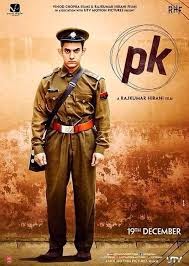
PK: Simplicity is not a simple thing

PK has been released just for a day and most people are out - intoxicated, as if "Pee Ke" aya hua hai. But like any other creation of art, a movie too can't be expected to touch everyone in the same way. Though mostly people are awed by the simple depiction of complex things, a very minuscule section of audience has found it, "even worse than a high school production", "just like OMG", "having a pathetic climax", "over hyped", "preachy", etc. Well, as I just mentioned any piece of art, and a good one that too, is expected to evoke extreme reactions, like Hyder did in the recent past. So there's nothing to debate about. 

PK is indeed worse than a high school drama which has more twists and turns and perhaps a better story. Yes, it neither has a good climax and I do accept that some good porns may have better climax. And yes, it's preachy, anything said against the convention sounds preachy. After all who wants to pay money to attend moral science classes when Astha and other channels offer everything free on air? And, yes, it's perhaps nothing more than OMG packaged and marketed in a better and suave way. So no debates on these points. Period. 


PK just reminded me of a few lines from Tagore, few of his songs, which have always inspired me. held me from breaking down, checked me from being insensitive, grounded me, handled me, saddled me tight for a bumpy journey, yoked me hard to the work-horse of my life, which just make me feel happy.

The first one is this line: Sahoj kotha bolte amay bolo je  / Sahoj kotha jay na bola sahoje. You ask me to say simple things? But simple things can't be said so simply!!

I'll just give one example how one very basic and fundamental but very complex phenomenon about the evolution of a language is depicted in the movie. PK, having learned a fully developed language (Bhojpuri in this case) in just six hours (in perhaps a pure theoretical way), finds the use of the same word in various unrelated and seemingly opposite situations very hilarious. He refers to the Hindi word "Achchha", which can be used in anger, tension, contemplation and suspicion. Most of the modern Indo-Aryan languages has this word, and use it almost in similar ways. It comes from the Sanskrit astu, meaning, let it be, be it so, or just a reality or mere existence (coming from asti, which is akin to Latin est, Old English ist and the present "is" in modern English). But how a word which etymologically means "is" expanded to express exclamation (Achchha!! Mamata didi has said she loves Modi!!) , interrogation (Achchha? How much did you say Mamata didi has sold her paintings for?) and anger (Achchha, Mamata didi has again blocked all roads in Calcutta,grrrrrrrrrrr) is indeed how languages have evolved over the years, and something which actually evokes surprise, when looked at logically. 

To elaborate more on this phenomenon, let me plagiarize Aurobindo's thoughts.

In the early days of human civilization whenever man wished to have words for abstract things, like strength, power etc., his readiest method was to apply simplistic ideas of physical actions.  Many words for strength across all languages had originally this idea of a force or injury because that was what it meant to the early humans to secure their existence and prove their strength and superiority in this world. The same is true for the Indo-European (IE) languages (Latin, Greek, German, English, Farsi, Sanskrit and all North Indian languages including Hindi/Urdu)

Let's consider all the related Sanskrit (Skt.) roots damsh, dams, daksh. The various words which evolved from these roots have quite diverse meanings. 

daksha, from the root daksh, means dexterous, intelligent, strong etc. in Skt., akin to Latin dexter, Greek doxa, all meaning strong.

damsa and dasra, from the root dams, mean wonderful deeds in Skt., coming from the original IE dans meaning to teach.

dasha, from the same root dams and damsh, means state or condition of life in Skt., akin to Latin decet, Greek decto, all coming from the original IE dek meaning respect, gain.

Another meaning of daksh is to hurt and that of dams and damsh is to bite, akin to Greek dakno.

Similarly the root kri in Skt. means to do, but also means to hurt. The Skt. kratu means resolution, power and is akin to Greek kratos meaning strong. It comes from the original IE root kert from which also come the Skt. kartati and Greek korno, meaning to cut.

So it can be seen that the original and nascent word for cutting, biting, hurting etc. evolves gradually to mean strength, power, resolution, respect etc. It also means to teach or to direct (original IE dans and Skt. dish). 

In all these major languages, the simple physical meaning of the words gradually gets complicated, profound, philosophical meanings. 

That's what has happened everywhere in all civilizations, culture, religion. So what we see now, in religion, culture, music, art, fashion, is a very convoluted and complex understanding of some very basic and simple concepts. Most problems in our society would be solved if we onion-peeled the complex layers and saw only the nascent simple thing. 


Is there a better and more simplistic way to explain such a complex thing than it was done in PK. And you say it preaching? The nakedness or the mismatched dress of PK are so simple symbols of the simplicity which forms the core of the film. Have you noted that PK came naked, but went dressed and when he returned to the Earth, RK (Ranbir) was naked, but PK was still dressed. That says all about the central idea of the film. Once you lose the simplicity it's so hard to get it back.

Then there's this Tagore song which I like very much. The concluding lines are:

Tomay niye khelechhilem khelar gharete,
Khelar putul bhenge gechhe pralay jharete.
Thak tobe shei kebal khela,
Hok na ekhan praner mela -
Tarer bina bhanglo, hriday-binay gahi re...

There were times we were engrossed in play
Till all toys were pitilessly dashed by a tempest.
We have had enough of playfulness-
It is time for one soul to meet another.
My severed lute-strings have lost their function,

But my heart shall emulate the melody...

When PK says that there's no language in his planet and that everyone directly communicates with each others mind, it's as if Tagore's words are being paraphrased, "we've had enough of playfulness; it's time for one soul to meet another..." 


Just imagine a world where everything is truth by construction. You directly read what's there in someone's mind and don't need to articulate your thoughts through sounds and gestures, which are always different, thus divisive, as is in today's world. A no-language-world is as Utopian as a single-language-world, but still, if we fantasized on something why not something that's correct by construction?

Now let me touch base little bit on some of the things which could have been better. The climax was actually very bad and overtly dramatic. But then when so much money is involved, the makers  had to play safe to some extent. Having said that, I should also say this, that many legendary movies or novels didn't have any story or climax. What was the climax in Pather Panchali. Isn't the story of Romeo-Juliet a single line? What's special about the story of Life is Beautiful? And Meghaduta? Happy New Year or Chennai Express had such strong story lines, but then that's also unacceptable to many. So it's not the story that matters. It's the way the characters get you involved with them, make you believe in them, feel happy and sad with them, that matters to the audience. 


Was it preachy? Every movie preaches because the bad always loses. How many movies have you seen where the villain is made to win? So let us not talk about whether any movie is preachy or not.


PK is a fantasy movie, showing on your face what you are and what you could have been too. 

Tuesday, December 9, 2014

The not so good effects of Cab-age

In the nineties if you wanted to get Venture Capital (VC) funding for your start-up, you had to be located preferably in the San Francisco Bay Area, better known as the Silicon Valley, in California, and surely working on something hi-tech. That was the time when companies like Google and Amazon, which changed our lives in ways beyond fathomable some fifteen years ago, were founded and funded. 

A fast forward to the present times. VC funding has changed a lot. You no longer need to be working on something hi-tech in some latest and greatest cutting edge technology to get VC funding. Nor do you have to be located in the Bay Area. Companies like Flipkart, Snapdeal, Myntra, Red Bus and many others have proved that VCs have really "globalized" and that their focus has changed too. Flipkart et al may not be working on the latest technologies, but they are indeed changing lives in India like perhaps Google and Amazon have been doing for the past one decade. 

One more genre of start-ups is getting lots of funding. They are the new age cabbies.

Gone were the days, anyway, of those black and yellow cabs (if not in other cities, but surely in Bangalore) you would wave your hands to stop by the road. We were already in the age of the radio taxies. But they were often not metered and there was always a grey area about the final amount you would pay. Often the drivers were not reliable. As a solution for all the maladies came the new age app-based cabbies, very much like saviors. You could now book a cab in just a few clicks on your smart phones. You would know exactly how much you have to pay. The drivers would be well mannered, reliable, always under surveillance and hence, surely trustworthy. They wouldn't charge you any thing extra. People across the country were just waiting for such a thing to happen. We were elated. Gone are the days, we all thought, of cab menace. The growing demand for such cabs excited the VCs, who started pouring in funds into it. Taxi4Sure, Ola, Uber and their likes made news with series of fat VC fundings. We all expected things to change for better. That's when there was a twist in the story.

With the aggressive advertisements of throw away goodies and amazing experience, a huge number of people really got interested in using cabs more and more. Some deals sounded so attractive that people even started using cabs in stead of their cars. That was indeed a great thing, given the state of the already congested roads in India. But, as the going says, nothing is fairy tale in this world.

I got the rude shock when I used Uber for the first time. Uber has already made roars in the west, trying to put the conventional cabbies off their jobs and attracting the wrath of the cab-unions in the US and Europe. Many people in the Bay Area are said to be preferring Uber to their own cars, given the hassles in parking cars in cities like San Francisco. I was excited about using Uber. I downloaded their app in my smart phone and booked a cab in just a few clicks, as expected and the cab too came on time. But while boarding the cab I was suspicious as there was no way to figure out if it was an Uber cab. The name "Uber" was written no where on the body of the cab. Neither was any identity card of the driver displayed in the cab, as has been the norm in most of the radio cabs. Perhaps Uber doesn't fall into the category of radio cab - it's app cab -, I thought. The only thing that gave me some confidence that the cab perhaps belonged to Uber was the iPhone the driver used to click the "Start" button before pressing on the gas pedal. So it was very clear that Uber doesn't conform to any of the norms that we were getting used to with the advent of the radio-taxies. The trustworthiness of the driver was a question, as was also the cab itself. It could have been any car, not even the one authorized by Uber. What authorization process does Uber follow? I did have the question in my mind. Soon a friend of mine told that once he had got a Meru Cab when he had booked an Uber. The driver of the Meru cab told my friend that he was authorized both by Meru and Uber. Not much later did we hear about an Uber driver raping a lady in Delhi. We came to know that that particular cab didn't even have the GPS system by which each cab is supposed to be tracked every moment by the operator. If the cab had the GPS and had Uber tracked it, as we expect from these new age cabbies, there wouldn't have been the rape. It's fairly a simple technology to figure out something amiss when a car suddenly stops (as it stopped when the driver raped the lady) for a long time during a trip in the middle of the night. So my suspicion of the first day of my experience with Uber about their authorization process and the trustworthiness of their drivers was not baseless.

Secondly, Uber doesn't have any customer care number. So if you're stuck with any problem you're at God's mercy. I heard when an Uber cab booked from Delhi airport declined to go to Noida and the passenger was dropped off in the middle, he could do nothing. Worse, the minimum charge was deducted from his credit card and he had to exchange many mails with Uber to get a closure on the issue. It's ridiculous to not have any customer care number.

Well, so how good are the other operators. All are facing tremendous teething problems and the customers are at a loss in many places. Meru has been advertising that if you pay through their wallet (sort of a prepaid system where you load a "wallet" with some amount and you've a cash less ride) you get a 30% discount. I loaded Rs 1100 into Meru wallet using their app. I received confirmation from credit card about the payment, but even after a day my wallet showed zero. In between I made a trip on Meru. Forget 30% discount, the driver insisted I pay him cash as my wallet didn't show any balance. Upon getting through their customer care after half an hour, during which I was seated inside the car, and shouting at the lady on the other side of the phone I got down of the car without paying anything to the driver. Even after a day, during which I tried reaching their customer care number of times, the wallet showed zero balance. Even now I don't know what has happened to the money that was charged by Meru but which seems to have gone into a black hole. The customer care was totally ignorant and I was asked to get in touch with credit card company to sort the issue.

Let's talk about Taxi4Sure now. They have really great deals, some of which are supposed to be cheaper than auto fares. Well and good. I was excited again, as I'm always a very pardoning and patient customer. I downloaded their app. It displayed that the nearest cab was 15 mins away from me. I was very happy. Wow, I said to myself. When I clicked on "Book" it said "Sorry". I kept on trying many times and every time it told the nearest cab was just few minutes from me but never could I book a cab. Here again it raises serious questions about the technology support. Such things ought to make me suspicious about their motive. 

I personally haven't used Ola and Mega for quite a while since both of them had failed to send cab and I had a terrible time at the last moment, struggling to arrange for alternative. What was atrocious was their inability to arrange for an alternative, leaving me in distress. But that was before the apps came into vogue.

I hope these are really teething issues and they may learn from their past mistakes. Nevertheless, the customer can't be made subjects of their beta testing. There's no doubt that consistently across all the operators, they lack several basic things and proper technology support. It's a question if they are trying to optimize their cost and knowingly ignoring several things or they are really trying to cope up with teething problems. Only time will tell. Till then, customers have no way than to get harassed and cheated.

Sunday, November 2, 2014

How my personal history inspired me to write a historical fiction

I heard a lot of stories about my father and uncle and grandmother. One particular episode, when my father – he was just seven then – left his mother and escaped to India with his elder brother who was just fourteen, would bring tears to my eyes whenever I listened to it from an old aunt who stayed with us. She would baby sit me and my young brother after our school as both our parents would be out at work. She would tell me the same stories again and again and I would insist on listening to this particular story. It was etched in my memory as if I was there, when all these were unfolding.

Later, when I grew up, I felt, this part of Indian history was not well covered either in literature or films. You get a lot of stuff about the Punjab side of the partition. But a similarly horrific episode of our history in the eastern side, the partition of Bengal, has been almost forgotten by the creative people. I felt someone should write about it. I knew that it would be very tough to write in a space filled with glorious works of the likes of Khushwant Singh and Amrita Pritam Singh, but then I’d already decided not to make my novel another partition saga. But the personal history indeed played a great role in the writing of my first book.
In fact it’s a well-known trend now a days. Many authors are taking their family stories and real life experience to a wider audience through their books. In a recent article in the Hindu, “Stories on Conflict”, (http://www.thehindu.com/books/literary-review/stories-on-conflict/article6274928.ece) Jaya Bhattacharji Rose said the following:

Contemporary sub-continental literature comprises storytellers who probably grew up listening to stories about conflict in their regions. It is evident in the variety, vibrancy and strength discernible in South Asian writing with distinct styles emerging from the nations. There is something in the flavour of writing; maybe linked to the socio-political evolution of the countries post-conflict —Partition or civil unrest. In India, there is the emergence of fiction and non-fiction writers who offer a sharp perspective, informed by their personal experiences, who are recording a historical (and painful) moment. Recent examples are Rahul Pandita’s Our Moon Has Blood Clots, Amandeep Sandhu’s Roll of Honour, Chitrita Banerji’s Mirror City, Sujata Massey’s The City of Palaces, Sudipto Das’s The Ekkos Clan, Shahnaz Bashir’s The Half Mother and Samanth Subramanian’s The Divided Land, a travelogue about post-war Sri Lanka.

I fully agree with Jaya. Writing from personal experience makes the story more authentic, poignant and realistic. In most cases the facts and figures are tweaked beyond any acceptable limits by authors to fit an incident into the realms of her literary works. But that makes the very incident look very unrealistic and readers may be able to catch the same very easily. I felt at ease the most while writing the chapters on Bangladesh. I almost everything, the setting, the backdrop, the people, the trees, the rivers, the villages, the horror in the eyes of the villagers. Incidentally most people have told me those chapters are perhaps the best chapters in the entire book. So I myself realized that when I write from personal experience, somewhere it becomes more poignant, more touching.

Wednesday, September 17, 2014

Cover Page of The Ekkos Clan

I authorize that anyone can use these pictures of the cover page of my book The Ekkos Clan for any purpose related directly or indirectly to me or the book.


Tuesday, August 5, 2014

Major Acts of Terrorism and Civilian Deaths in Recent Times


The graphics speak everything. I've taken some of the high profile cases in the recent past. There are many other events which I've ignored not with any particular intention or prejudice. The events I've considered seemed to be sufficient for the context in which I wanted to see the various acts of terrorism in the recent past and the civilian casualties in each case. I include genocides perpetuated by states or terrorist organizations alike in the list as from the human perspective, both are same. I've excluded full fledged wars. Finally these numbers are predominantly from post World War II period, with a preference to more recent events.

One thing that's very striking is the predominance of the various Arab and African countries massacred by tyrannical dictators. Saddam Hussein comes closest to Hitler or Stalin in terms of ferocity and the extent of the terrorism he had inflicted on his own people. He has killed at least 1 million people in Iraq.

Jean Kambanda killed a whooping 800K people in Rwanda and Idi Amin 300K in Uganda. Omar Al-Bashir killed 200K people in Sudan and Bashar al-Asad 180K in Syria. Taliban killed 400K in Afghanistan before the US strikes, after which they killed 16K.

Having killed only 5K and 10K people respectively, the Al Qaeda and Gaddafi look like kids in front of the others.

50K civilians were killed in the thirty years of conflict between the LTTE and the Sri Lankan state. It's not easy to say how many of these 50K were killed by LTTE and how many by the state. In terms of sheer number, given the size of Sri Lanka, this is indeed huge.

In the Israel-Palestine conflict, a total of 90K Palestinians have been killed till date, since the 1920s. The toll on the Israeli side is 25K. In the recent Israeli offensive against Palestine, only 50 Israelis have lost their lives against a whooping 1000 Palestinians.

In the East the massive genocides were by Pol Pot in Cambodia, killing 17 million people (couldn't be included in the chart as it would go out of bounds), Suharto in Indonesia, killing 500K, and Ho Chi Min in Vietnam killing 200K, against 70K killed by the US president Richard Nixon in the Vietnam War.

What intrigues me is why there wasn't this much of protest against Iraq or Libya or Syria in the recent times as we're now seeing against the Israeli offensive. It's not that we were not aware of Saddam's killings. But India had cordial ties with Iraq all throughout. Why wasn't there any protest from any quarter in all those decades when Saddam continued to be a friend of India? Why wasn't there any protest against the killings of so many people in Libya or Syria? Why do people awake only when Palestinians are killed in their ongoing conflict with Israel? Just because here, the Muslims are being killed by Jews and there, Muslims were killed by Muslims, are we concerned more about the Palestinians? What standard or code of morality are we following?

My friend Raja says, the question on Palestine-Israel conflict has historically gained attention because of multi-dimensional view around it - religious, racial, geo-political, strategic and the media emphasis on all of these. Countries opt to support or remain silent for (stupid) political reasons - India's silence on Myanmar for decades is well known as an example. The other main reason is relatively indifferent attitude towards region/people in the less 'fortunate' and poor areas - like many countries in Africa.

Atanu adds, we should demand upon ourselves an ethical equivalency in our response to all crises and suffering across the world. However we should start with our own personal responses before demanding it on others.

Debraj brings in a new spin. He says, such deaths/killing are natural outcomes of over population - nature's way of maintaining equilibrium. It is not obvious, however, with more population, there is an fiercer underlying competition of access to resources, which finally ends up in such killing under various religious or caste or ideological names. I agree this is too simplistic, but I think this angle needs some research...

Reference:
  1. http://www.nytimes.com/2003/01/26/weekinreview/the-world-how-many-people-has-hussein-killed.html
  2. http://www.huffingtonpost.com/ali-a-rizvi/picking-a-side-in-israel-palestine_b_5602701.html
  3. http://www.theguardian.com/news/datablog/2010/aug/10/afghanistan-civilian-casualties-statistics
  4. http://npsglobal.org/eng/news/29-non-state-actors/1034-al-qaeda-attackss-death-toll-more-than-4400-lives.html
  5. http://www.washingtontimes.com/news/2010/jan/14/al-qaeda-hurts-muslims-most/?page=all
  6. http://www.jewishvirtuallibrary.org/jsource/Terrorism/palterrortoc.html
  7. http://www.scaruffi.com/politics/dictat.html
  8. wikipedia

Monday, August 4, 2014

Why societies glorify oppressed and tragic women? Because men have been always men

Has it ever occurred to you that we, as a society, male dominated that is, are comfortable seeing women always in the ghisa-pita cliched role of an oppressed abla nari? You may argue that things have changed and now women and men are at par, that women are driving everything from trucks to big companies. Yes that's true, but there too, when we look at them, we perhaps, even unknown to ourselves, tend to glorify not their achievements, but the pains they had to endure in order to achieve what a guy would have achieved without that much pain. When someone like Kiran Bedi is talked about, we highlight more the oppression she had to face from the system, than her real achievements. When we glorify her, what we actually do is sympathize with her struggles, her pains in fighting against a system shamelessly skewed against women, as though, her existence, her achievement, everything revolves around the oppression. Here oppression is not always a physical or mental thing caused by others, it can also be self imposed. I'm sure, after we heard that Indra Nooyi had to struggle so much to strike a balance between her personal life as a woman - mother, wife, daughter - and her profession, our respect for her increased manifold, as though without all those she was not a complete woman. The fact that Kiran Bedi, at the end of her career, was wrongfully declined the opportunity to become the DIG of Delhi made her more acceptable to us, like Indra Nooyi is now, in the role of an ideal woman, someone who has endured a lot, struggled a lot and has been deprived of many things in life.

This actually falls in line with the motifs often used to depict women across the ages in all cultures. For example, in many Greek mythologies, a woman is first shown as a virgin girl. Then she transitions into a woman and mother. Then there’s a phase of extreme sadness and solitude. The final element in her story combines both death and apotheosis. Stories of most women characters roughly follow this stereotype script. It's irresistible to not deprive a woman of her dose of sadness and oppression and struggle. To the advantage of the men, all top poets and bards have been always males, since the beginning of human civilization. It's no coincidence that Homer, Vyasa and Valmiki were all males. So it's not surprising that when they created 'perfect' women characters, they too didn't forget the doses of tragedies. They knew very well that 'tragic queen' sells. It sold then, it sells now too. 

It's perfectly logical that someone like Sonia Gandhi would be the most powerful woman politician in our country. Just yesterday I read that Natwar Singh, in his autobiography where he spilled lot of bins about the Gandhi family, has mentioned that Sonia's life is like a Greek tragedy. I'm not sure if he too wanted to bring out the same point I'm talking about now - that Sonia's popularity is greatly because of the perception in our minds that she is a tragedy queen. It also matches so well with the motif so often used to depict women. She had a fairy tale life, dating the son of one of the most powerful women in the world and the Prime Minister of India. After the Mills-n-Boons courtship and marriage, she suddenly became the first lady of India, after a catastrophe in her life - the assassination of her mother in law Indira Gandhi and the sudden accession of her husband Rajiv Gandhi to throne of India. This was the second stage of her life which was followed by the third stage of extreme sadness and solitude - she lost her husband. And then in the last stage we see her as the most powerful goddess in the political pantheon. It can't be denied that her wide acceptance and popularity, which is no less than apotheosis, is predominantly because of her tragic life. We love to see women as tragedy queens. We loved then, we love now too.

Has it ever occurred to you that we, the guys in the guys' world, follow the same principle even in our religion? Why do you think Sita gets such a special treatment by us whereas someone like Draupadi comes no where to the status accorded to Sita? If you see things without any prejudice, as they are, Sita's life is full of tragedies, starting from her birth. When she grows up, she's married to a family that sends her to exile for no fault of hers. Her husband Ram is depicted as though he is the epitome of decency, loyalty, generosity, faithfulness, truthfulness - we may exhaust words. He doesn't protest when his father asks him to go and stay in jungle. Does anyone ask Sita about her likes and dislikes? She is shown as a loyal and faithful wife who considers putting forth her likes and dislikes blasphemous, as though, wives don't have any. She accompanies her husband to the jungle, is kidnapped by a notorious villain, and then saved by his husband, but not before spending some good amount of time in an alien land in captivity. The tragedy doesn't end there. When times comes for her and her husband to get back to home, she is left behind in the jungle because her husband's folks feels she's a noshto meye, spoiled girl, having spent those days of captivity with Gabbar Singh. Even Sholay gave more respect to Basanti, who was kidnapped by the real Gabbar, than what we've accorded to Sita. Left behind in the jungle, she raises her kids alone. Let me not proceed further. There are more tragedies for her. Of course there are justifications for everything provided in Ramayana. Whatever they may be, on the face of it, we can't decline that Sita has been depicted as one of the million oppressed house wives we see all around our country. She is nothing more than a doormat. She doesn't have any respect. She can't speak out. She has to accept whatever her husband decides. No wonder she is so widely worshiped. We, the guys, have created her and placed her on the throne, because we love her - who else has seen such catastrophes in life, silently, without any protest?

Draupadi has her stock of tragedies too, but nothing matches with those of Sita. Moreover, the characterization of Draupadi doesn't make her look like a doormat. Her five husbands respect her, never leave her in jungle and above all she has her cool dude bro protecting her always. Sita is never protected. That makes her the perfect candidate to be glorified. She's the tragedy queen, the quintessential epithet of an oppressed woman. She satisfies the male ego. 

Men are men, across the world, in all ages.

Thursday, July 31, 2014

Israel Palestine Conflict: Is the general reaction towards Israel's offensive a variant of the Stockholm Syndrome?

Disclaimer at the beginning: My article is no way in support of the Israeli offensive against Palestinian people. But at the same time, it's not harmful to have a different perspective to the whole thing.

India and Israel were born almost at the same time - India on 15th August, 1947 and Israel on 14th May 1948. And interestingly, both were born out of partition plans made by none other than the British. India was partitioned on the basis of religion to carve out an Islamic Pakistan. A similar plan was used to carve out Zionist Israel and Arab-Muslim Palestine. Coincidences don't stop here. Like the Muslim Pakistan comprising two appendages in the east and west, the Arab-Muslim Palestine too comprised the Gaza strip in the west and West Bank in the east (Yes, it's like West Bengal in the east of India) of the newly created Israel. But, over the next six decades, the affairs between India and Pakistan haven't come to the state as they are now between Palestine and Israel. Of course, India never struck against Pakistan like Israel has always done, though state and non-state sponsored terrorism in (P)alestine and (P)akistan have constantly targeted (I)srael and (I)ndia in similar ways. Indian being  a soft power with lofty ideals has failed miserably to tackle Pakistani terrorism. There's no guarantee that incidents like 26/11, where terrorist attacks at various parts of Bombay were planned and executed by Pakistan, will not occur in future. But similar incident can't ever occur in Israel, come what may, and the reason is very simple - Israel's offensive against anything that's Palestinian.

A close study of the history of the various events in that area leads me to the thought that Israel has been always in the retaliation mode since its creation in 1948 and retaliation is always manifold stronger than its cause. Interestingly, history has been always sympathetic to the cause and illogically harsh to the retaliation, perhaps which leads to my reference of the Stockholm syndrome. The USA is always condemned for the nuclear strikes against Japan. But is Japan condemned in the same way for its attack on Pearl Harbor? Had there been no Pearl Harbor there wouldn't be any Hiroshima and Nagasaki. I just gave one example, but history has many such instances where retaliation has been very horrific. I find no reason why it shouldn't be. Just see the impact of the nuclear attack on Japan. The World War II came to an end in no time, the holocaust too ended. But still the USA have to bear the ignominy of Hiroshima and Nagasaki for ever. Aren't we excessively sympathetic to Japan and illogically harsh to the USA? They just retaliated and that's what Israel has been doing always. Let us go back to the history a bit before pointing all our guns against Israel.

The Ottoman Empire has been degenerating fast. The last nail in their coffin is their aligning with the Germans in the World War I. 

  1. 11 November 1914: The Ottomans become German ally
  2. 24 October 1915: The British High Commission at Cairo, Sir Henry McMahon, sends a letter to the Sherif of Mecca, Hussein bin Ali. He assures that if the Arabs fight against the Ottoman, then the British Government would "recognize and support the independence of the Arabs within the territories in the limits and boundaries proposed by the Sherif of Mecca", with the exception of certain areas, which don't explicitly mention Palestine, but would later be claimed to have included it through the ambiguous reference to "portions of Syria lying to the west of the vilayets (districts) of Damascus". The Sherif doesn't raise any concern with the wordings of the correspondence. By the way, this British High Commission is the same McMahon who, just a few years ago, was instrumental in creating the McMahon line which still serves as the boundary between India and Tibet - more India connection.
  3. 5 June 1916: The Arabs, under Faisal, a son of Hussein, the Sherif of Mecca, start fighting against the Ottomans. T E Lawrence, popularly known as the Lawrence of Arabia, immortalized by David Lean's eponymous movie, plays a great role in convincing the Arabs to support the British forces against the Ottomans. 
  4. 2 November, 1917: James Balfour, Foreign Secretary of the UK, declares that UK favors the "establishment in Palestine of a national home for the Jewish people". One of the main proponents of the Jewish Homeland is Chaim Weizmann, a leading spokesperson in the UK for Zionism and an acclaimed chemist whose inventions in explosives are much needed by the British to counter the Germans. The declaration is also seen as an attempt to please the US president Woodrow Wilson two of whose closest advisers are avid Zionists and who hasn't yet joined the World War. 
  5. 23 November, 1917: Just after the Russian Revolution, the Bolsheviks expose an agreement, known as Sykes-Picot Agreement, signed between UK, France and Russia on 16 May, 1916, which divided the Arab provinces of the Ottoman Empire outside the Arabian peninsula into future regions of British and French control. Balfour Declaration along with Sykes-Picot Agreement contradict with what McMahon had assured to Hussein, the Sherif of Mecca, earlier about the recognition of the independence of the Arabs. Even then, various officials of the British government manage to convince Faisal, Hussein's son and Hussein that they are still committed towards Arab's independence. It's argued that the Jewish Homeland mentioned in the Balfour Declaration is not same as a Jewish State in Palestine. UK sticks to its interpretation of McMahon-Hussein correspondence that Palestine was excluded from the areas of Arab independence and that it's in sync with both Balfour Declaration and Sykes-Picot Agreement.
  6. 18 January, 1919: Paris Peace conference starts following the decisive end of World War I. More than one and a half year later Treaty of Sevres, which finally decides the fate of Palestine, is signed on 10 August 1920. Palestine and Iraq are placed under British Mandate and Syria and Lebanon under French. The Palestine Mandate consists of two regions, one to the west of Jordan River, known as Palestine, and the other to the east, known as Transjordan, an autonomous region placed under the Hashemite family of Hijaz. The erstwhile Hijaz vilayet or province under the Ottoman Empire included Mecca and Medina. Hijaz is presently under Hussein bin Ali, the Sherif of Mecca who was assured of Arab independence by Sir Henry McMahon in 1915 and who has recently claimed Hijaz as a part of that assurance. Iraq would be soon placed under Faisal, a son of Hussein of Hijaz.
  7. 1 July, 1920: Civilian government starts in Palestine Mandate under British High Commissioner Herbert Samuel. The Treaty of Sevres had acknowledged clause of Jewish Homeland in Palestine as per the Balfour Declaration, but had also mentioned that the interests of the other people wouldn't be hampered. The British Mandate for Palestine is opposed by the Arabs, whose interpretation of the McMahon-Hussein correspondence included Palestine as a part of the region which would be independent under them. Nevertheless, initially the relation between the Jews and the Arabs in Palestine is cordial.
  8. Over the next few years a hard line Palestinian Arab Nationalist movement gains momentum under Amin al-Husseini. Massive anti Jewish riots erupt in many places leading to heavy casualties to the Jewish people. This heralds the beginning of the Jewish retaliation with the founding of several underground militia groups and Jewish paramilitary force. The violence continues with Arabs pouring in from the neighboring Syria to boost the fight against the Jewish people in the thirties. Over the next eighteen years, during which the World War II begins and ends, it becomes very clear that the Arab Muslims and the Jews can't stay together in Palestine and that a partition, with Gaza strip and West Bank going to the Arabs and the rest of the British Mandate going to the Jews, is imminent.
  9. 29 November, 1947: General Assembly of the newly formed UN recommends the partition of Palestine. Expectedly, the Jews accepts the recommendation but the Arabs oppose, resulting in another series of violent clashes between the two, with the Muslims supported by the Arab League . Here also, the Jewish stand at the beginning is defensive and occasionally retaliative. But things change gradually, with more Jewish veterans of the World Wars joining the struggle. The Jewish offensive is strengthened by the underground militias which were formed in the previous decade during the early stages of the Arab-Jewish violence. By the spring of 1948 the Arab forces are a total collapse. 
  10. 14 May, 1948: The State of Israel is born a day before the British Mandate for Palestine would come to an end. The Arab League intervenes on behalf of the Palestinian Arabs. Thus begins the Arab-Israel War. Jordan occupies and later annexes West Bank and Egypt takes over the Gaza Strip.
  11. 22 September, 1948: All Palestine Government is declared by the Arab League in Gaza. Through the 50s Egypt and Jordan keep on supporting militant activities against Israel, who is left with no option than to carry on reprisal operations, which continue till date.
Without any prejudice anyone can infer that the Zionists, from the beginning, wanted to create a Jewish Homeland through dialogues and negotiations. If the Arabs can claim their nativity in the Palestine, the Jews can also do the same on same land which was part of the much older Israel Kingdom. After the holocaust and the outcome of the World War II, it was very logical for the homeless Jews to think of returning to their historical homeland, which presently was placed under a British Mandate and no longer a part of the Ottoman Empire to which the Arabs could claim their sole ownership. The World Wars created many new countries, mostly impacting the losing parties, of which the Ottoman Empire was perhaps the biggest loser. It's expected that they would be impacted the most. The erstwhile Islamic Ottoman Empire having collapsed, the idea of the Islamic states at all its erstwhile regions was out of question. Nevertheless, major parts of the erstwhile Ottoman Empire emerged as Islamic States (Iraq, Syria, Lebanon, Jordan, Hijaz etc.) The relatively smaller area of Palestine not being recognized as an independent Arab State shouldn't have been a big issue for the Arab League who were suffering from the shock of the demise the Ottoman Caliphate and the loss of Arab control over Middle East. But that was an eventuality which they had no other option than to accept. Had the Ottoman Empire sided with England and France, then things would have been totally different, but then that's just a wishful thinking. 

When the partition of Palestine between the Jews and the Muslims was imminent, there was no reason for the Arab League to oppose that. Had they not done so, there wouldn't be the present state of affairs between Israel and Palestine. The first violence between the Jews and the Palestinian Muslims was triggered not by the Jews, but Arab nationalists from outside Palestine, when Palestine was still under a British Mandate. With the formation of Israel, the external forces kept on instigating offensives against them and the outcome is of course the present sad state in that region. 

To bring back my India-Israel analogy, let us consider a scenario where India has rejected the plan for the Partition of the Indian subcontinent as proposed by the outgoing British government and all the neighbors of India - Russia, China, Thailand and Malaysia - join hands with India against Pakistan. What do you think Pakistan would do? Would they keep quiet and allow India along with its neighbors bully him? Of course not. They would do exactly what Israel has been doing for the past six decades. It's altogether a different thing that Pakistan anyway has been striking against India in as many was as possible without any provocation from the Indian side. India has been mostly acting like a matured big brother, not retaliating against Pakistan time and again. But has that stand improved the situation? Has the safety of our country been guaranteed by the soft stand taken against Pakistan? No. But, just think about it, would you ever see anything like 26/11 in Israel? No. Never. 

Now coming back to the original point of the reaction towards Israel's offensive. Yes, it's horrific, condemnable in all standards. But without this ultra strong stand, would Israel exist in that region? Would you  all be fine if the Israel State were annexed into an Islamic State of Palestine? If you're fine with that, aren't you actually showing symptoms of Stockholm syndrome because the first aggressor was not Israel? It's sad that the first aggressor in this case was neither Palestine - it was the Arab League.