Monday, March 7, 2016

Women...


It’s again a Women’s Day and the whole world will celebrate the spirit of women, talk about women power, cite examples of the remarkable women round the world and of course shops will give discounts to women and restaurants will have “women” theme parties. Many corporates have started inviting dieticians and health consultants to come and give “tailor made” speeches to their women employees and give them tips to stay fit and healthy. All great things on a great day. But somewhere, there will be still a big disconnect between what we intend to do and what we’ve been doing since ages.

When I say “we”, I mean the men in general, the males who have been ruling the world for ever. It’s not a cliché that all societies have been predominantly male dominated. We were always the rulers, in India and elsewhere, and we’ve always seen women through our prism, a male prism. Will another or many more Women’s Day really change the status of women in our society? That’s not the premise of this article though. Rather, let us see what this male prism is, through which we’ve been seeing women all along.

India may fair pretty badly in most of the human indices related to women. Female foeticide, atrocities towards women in the form of dowry deaths, rapes etc. are indeed glaring things which stand out starkly. But there is much more than just the numbers and statistics.

Has it ever occurred to us that most of the cuss words in any culture and language and country are always female sexual organs that grossly objectify women, or men acts that intend to subjugate or dominate women, mostly sexually? The famous “F” work in English we can’t do without and which perhaps falls in all the eight parts of speech is nothing but a symbol of a violent sex with a woman. The intensity with which the term “Fuck You” is meant to be said is perhaps an indication of the intent with which it was coined as a cuss word. A compassionate sex with a woman is never called “fuck”. It’s not that men can’t be sexually abused or subjugated. But we don’t even have a word for that, forget making that a cuss word.

Back home, the “F” word is perhaps not that predominantly used as are the “S” and “C” words. “Sala”, the benign “S” word, is not even considered a cuss word. But we forget the origin of the word. Whenever we say someone “sala” we actually mean “I fuck your sister”. Coming to sister, that’s an integral part of cuss words, along with mother. Here too, father and brother are spared. It may be argued that the when it’s a sister or mother, the ghastliness of the acts justify their being considered as hard core cuss words. Here too, indirectly we’re saying that men can’t be subjected to such ghastly acts because they are powerful.

The ancient Greeks have been great thinkers and philosophers. They have been lauded for centuries for their open mindedness. Greeks were always an emancipated lot. Greek myths are sexually explicit. Many Greek myths are unusual. We’ve Oedipus who desires his mother sexually. Then there are lots of cases of incest. Zeus’ consort Hera happens to be his sister. Zeus also has sex with Calisto. Calisto’s friend Artemis is Zeus’ daughter – so Zeus has fathered his own daughter’s friend. There’s also a lot of male same sex love in Greek mythology. But comparatively, a lesbian theme is rarely found. It reminds me of a sarcastic dialogue from the film Ishqiyan, where Babban played by Arsad Aarsi complains to Khalujan, Naseerudin Shah, “your love is love and love is sex?” When it comes to homosexuality, males have the license, but for women it’s a taboo, even among the ancient Greeks.

Sappho, perhaps one of the earliest women poets of the ancient times, was ignored majorly by her Greek and Roman successors because of her homoerotic involvement disgraceful for a female. In other words it means she was considered outcaste because she was the first female LGBT activist of the world to talk about lesbianism. Wisdom prevailed in contemporary times when the term lesbianism was coined after Lesbos, the Greek island she was born in.
The Greek myth of Calisto perhaps represents all the motifs commonly used to depict women across the ages. She is first shown as a virgin girl, wild and boisterous, a huntress that runs around in the jungle. Then she transitions into a woman and mother. She has sex and gives birth to a boy. Then there’s a phase of extreme sadness and solitude when her motherhood is wrenched from her. She is turned into a bear and exiled in the jungle. The final element in her story combines both death and apotheosis. She is nearly killed by her son when Zeus rescues her at the last moment and enshrines her in the sky as Ursa Major, the Great Bear constellation.

Stories of most women characters roughly follow this stereotype script. It's irresistible to not deprive a woman of her dose of sadness and oppression and struggle. To the advantage of the men, all top poets and bards have been always males, since the beginning of human civilization. It’s no coincidence that Homer, Vyasa and Valmiki were all males. So it’s not surprising that when they created “perfect” women characters, they too didn’t forget the doses of tragedies. They knew very well that “tragic queen” sells. It sold then, it sells now too.

Back home, it was perhaps not palatable for many to accept a strong woman like Draupadi. Rather, people were happy with Sita, a character that fits very well into the clichéd typecast of a woman we are so used to see. It’s as if, as we’ve seen in the case of Calisto myth too, unless a woman goes through a phase of extreme sadness and solitude, she can’t be a woman. Sita is a typical Indian woman. She is loyal to her husband. She rarely opposes her husband or in-laws. She didn’t say a single word when her husband decided to go to  jungle and spend fourteen years. It’s perhaps not clear if her husband at all had asked her before taking the decision. Yes, it’s true that her husband was driven by lofty ideals and the sense of duty. But does that alone justify her ordeal?

To add to Sita’s woes she is kidnapped by a demon, and then when she is finally rescued and is ready to return home, with her husband, she’s left behind in the jungle on a very flimsy ground. In all this, she always maintains a stoic silence, as though as a woman anything and everything can happen to her and it’s her duty as a woman to endure it all. Calisto doesn’t have much in common with Sita. But both have been typecast in a typical way that would evoke sympathy. The Greeks never worshipped Calisto, but in India Sita is worshipped. She is seen as the ideal wife, ideal daughter-in-law and also an ideal mother, who raises her kids alone in the jungle. All throughout, it’s a sad story of sacrifice, solitude, exile and utter neglect.

On the contrary Draupadi is strong. She has five husbands and she manages all of them quite well. Though polyandry was not uncommon in India, still the symbolism of a woman married to five men is much beyond a mere tradition. It perhaps speaks of her position, her strength. She too goes through her share of pain, but nowhere she has been shown as helpless or left alone, like Sita. But alas, her position in the Indian pantheon is nowhere near that of Sita. The very fact that we’ve chosen to worship Sita and relegate Draupadi to a mere character in an epic talks volumes about our attitude towards women. But we shouldn’t be ashamed more because had Sita been a Greek character her fate wouldn’t have been different. We don’t like strong women, in general.

There’s one interesting thing about Draupadi which might have eluded most of us. It’s said that Arjun wins Draupadi at the swayamvara and the five brothers bring her proudly to their mother Kunti. “Mother,” they say, “see what we’ve brought.” At this point, it’s ridiculously claimed that Kunti thinks his sons have brought the daily provisions. She asks the five brothers to divide it equally among them – that’s the justification given for Draupadi’s marriage to all the five brothers. A writer like Vyasa couldn’t have written this. It’s said elsewhere that Kunti herself divides the daily provisions and that the provisions are never divided equally – Bhim gets half and the remaining half is for the rest of the family. This very incident of Kunti asking the Pandavas to share it equally is very likely a later insertion, in an attempt to justify a case of polyandry, and prevent Draupadi from being seen a strong woman.

Another very strong character, Kunti, has also been totally neglected in the same way. We have given lofty alters even to snakes and trees, as Gods and demigods, but we have failed to give strong women like Draupadi and Kunti any place in our exploding pantheon, where Sita is the uncontested Queen.

It's perfectly logical that someone like Sonia Gandhi would be the most powerful woman politician in our country. Natwar Singh, in his autobiography, has mentioned Sonia's life is like a Greek tragedy. I’m not sure if he too wanted to bring out the same point I’m talking about now – that Sonia’s popularity is greatly because of the perception in our minds that she is a tragedy queen. It also matches so well with the motif so often used to depict women. She had a fairy tale life, dating the son of one of the most powerful women in the world and the Prime Minister of India. After the Mills-n-Boons courtship and marriage, she suddenly became the first lady of India, after a catastrophe in her life – the assassination of her mother in law Indira Gandhi and the sudden accession of her husband Rajiv Gandhi to throne of India. This was the second stage of her life which was followed by the third stage of extreme sadness and solitude – she lost her husband. And then in the last stage we see her as the most powerful goddess in the political pantheon. It can’t be denied that her wide acceptance and popularity, which is no less than apotheosis, is predominantly because of her tragic life. We love to see women as tragedy queens. We loved then, we love now too.

Having said all these, India still fairs better than many other countries and cultures when it comes to dealing with women. Not many cultures have a powerful goddess like Durga who rides on a lion and kills the most ferocious and invincible demon. There’s a motif of a female riding on a lion found in a seal from the Bactria Margiana Archaeological Complex, an ancient civilization in the Northern Afghanistan (Bactria) and Turkmenistan (Margiana), contemporaneous to the later phase of the Indus Valley Civilization. It’s possible the idea of a strong Mother Goddess evolved from older concepts prevalent in the Central Asia anterior to 1500 BC. This doubtless makes cult o Durga one of the earliest instances of worshipping the power and strength of a woman, not her sadness, solitude and helplessness.

Maitreyi and Yagyavalka may be among the foremost writer-couples, having composed parts of the Brihadaranyaka Upanishad. Most of this Upanishad is written as dialogues between the couple, who are shown to be discussing and debating deep philosophical and intellectual stuff. Even a very conservative dating of Maitreyi may lead us to 7th or 8th century BC, which makes her one of the earliest women writers in the world. There are not many instances in the ancient world where a woman is shown in the same platform as a man in the context of intellect and philosophy.

India has a long tradition of empowering women in various ways. The Buddha has been shown to attain nirvana after accepting milk-rice from Sujata. This may be mere legend, but given Buddha’s symbolism in many things, the importance of Sujata is indeed much more than a woman who had once fed the Buddha.
It may not be a mere coincidence that much later, India produced one of the strongest woman empresses in the Muslim world – Razia Sultan. That India allowed such a thing to happen, which would have been impossible to even think of in the Arab countries, does tell something about Indian women.


Despite the not-so-palatable state of status of women in the Indian society, women like the Goddess Durga, Maitreyi, Sujata and Razia do instil hope into the system. But most important is the need of a shift in the attitude of the men towards women. As long as ma and behen continue to play such an important role in our cuss-vocabs, as long as we continue to glorify apparently weak women, as long as we keep on shunning women from places of worship, just a token Women’s Day may be another whim of the MCPs.

Saturday, March 5, 2016

The Legacy of Bacha Khan: A Unique Case Study of “Nonviolence” in Islam


Lately, Peshawar has been in the news for all the bad reasons. First it was the attack on the Army Public School on 16th December 2014, carried out by seven gunmen affiliated to an offshoot of the Taliban, killing 132 children. Then it’s the recent attack on the Bacha Khan University in nearby Charsadda, on 20th January, purportedly by the same group, killing 21 people.

Interestingly Peshawar, the capital of the erstwhile North West Frontier Province, presently Khyber Pakhtunkhwa, is one of the oldest continuously inhabited cities in the Indian subcontinent, with a very strong legacy in art, culture and religion that transcends the boundaries of Pakistan and India. Peshawar, and that entire region, also happens to be the karmabhoomi of Bacha (Badshah) Khan, the legendary Pashto leader Khan Abdul Ghaffar Khan, an apostle of nonviolence and a close aid of Mahatma Gandhi.

The history of Peshawar, and especially that of Bacha Khan, who lends his name to the University where the recent attack happened, don’t seem to go hand in hand with the present state the entire region has got into. The glorious past and the legacy left behind by Bacha Khan were all indigenous to the region. It was not something that any external agency had created for them, unlike the thousand legacies left behind by the British on India. The cultural heritage of that region is very much rooted there, not anywhere else. So it shocks more when we see what it has degenerated into now. The most striking thing of that place is indeed Bacha Khan’s tryst with nonviolence, something the towering personality had started preaching and practicing totally independent of Gandhi. It could very well be a case study in itself, when seen in the context of Islam, or rather the Islam he believed in. It’s intriguing why his interpretations of Islam, which he used to justify his faith in nonviolence, doesn’t find any resonance now.

It’s paradoxical that, at a time when certain interpretations of Islam have been fuelling a sort of violence and terrorism not seen before, no one wants to talk about Bacha Khan’s nonviolence. It’s as though, the moment you talk about that, you indirectly accept Islam can also be interpreted in a different way, and thus, you would accept this too that the other interpretation is questionable, or rather wrong. That’s where lies all the problem – no one is ready say that the king is naked.

Let us go back and look into the history a bit. Peshawar had a famous dagaba (dhatu-garbha in Sanskrit meaning a receptacle for sacred ashes or relics) enshrining the begging pot of the Buddha. It was constructed by the Kushana Emperor Kanishka in the 2nd century AD. The sacred relic was taken to Vaishali, and then to Kandahar, where it’s still believed to be preserved and revered by the Muslims.
When the Chinese monk and traveler Fah Hien passed through the province in the 5th century he describes the dagaba at Peshawar as “more than 470 ft. in height, and decorated with every sort of precious substance, so that all who passed by, and saw the exquisite beauty and graceful proportions of the tower and the temple attached to it, exclaimed in delight that it was incomparable for beauty”. He adds, “Tradition says this was the highest tower in Jambudwipa.”
When Hiuen Tsang passed that way more than 200 years later, he reports the tower as having been 400 ft. high, but it was then ruined. It doesn’t exist now.
Kanishka is represented as a Buddhist, beyond all doubt. He held a convocation at which Nagarjuna was apparently the presiding genius. From about that time the Tibetans, Burmese, and Chinese date the first introduction of Buddhism into their countries. Nagarjuna essentially spread Buddhism, from Peshawar, over the whole of central and eastern Asia. It was precisely analogous to the revolution that took place in the Christian Church, about the same time after the death of its founder. Six hundred years after Christ, Gregory the Great established the hierarchical Roman Catholic system.
So the Sanskrit Purushapura, which Akbar Persianized to Peshawar, the Frontier Town, happens to be an epicenter for Buddhism. At Jamalgarhi, 36 miles NE of Peshawar, and Takht-i-Bahai, 8 miles further westward, the ancient monasteries exist till date.
Charsadda, where the recent attack happened, is identified with the ancient Pushkalavati, another important Buddhist site.
Peshawar still has the Qissa Khawani Bazar, the Story Teller’s Market. It’s not for nothing that the qafilas have been bringing the Afghans, Persians, Turkomans, Uzbeks, Russians and many others from round the world to this place, for two thousand years, since the time of the great Kanishki Namworr, as was the Kushan Emperor Kanishka often referred to in the old inscriptions.

Everyone who came here had a story to share and that’s how this market came to be known as the Qissa Khawani Bazar, the Story Tellers’ Market. For thousands of years the people have listened to these stories of the world. The followers of Bacha Khan created their own story on 23rd April, 1930. It was the story of the honesty and truthfulness of the Pashtuns, the story of sacrificing their wealth, life and comfort for the liberty of Hindustan, the story of their lives in accordance with the principles of adam tashaddud, nonviolence, preached by their leader, Bacha Khan.

With his affable but stupefying personality, as towering as his tall height, and the earnestness in his speech, Bacha Khan had hypnotized many young minds. Sometime back, he had given a mesmerizing speech at Utmanzai, his birthplace, not very far from Peshawar.

“I’m going to give you such a weapon that the police and the army will not be able to stand against it. It is the weapon of the Prophet, but you’re not aware of it. That weapon is sabr, patience, renunciation of all violent retaliation and righteousness. No power on earth can stand against it. When you go back to villages, tell your brethren that there is an army of God, and its weapon is sabr. Ask your brethren to join the army of God. Endure all hardships. If you exercise sabr, victory will be yours…”

Bacha Khan had formed the Khudai Khidmadgar, Servants of God, the previous year. Such was the popularity of Abdul Gaffar Khan, anointed as Badshah Khan, the King of Khans, that even his reference would augur a feeling of reverence among his people. Such a level of acceptance among the Pashtuns was perhaps because he had instilled new vigor and honor into Pashtunwali, the Pashtun way of life, giving the violent people a new meaning to their lives which had been relegated to bad blood and savage killings.

He would say, “There is nothing surprising in a Muslim or a Pathan like me subscribing to the creed of nonviolence. It is not a new creed. It was followed fourteen hundred years ago by the Prophet all the time he was in Mecca and it has since been followed by all those who wanted to throw off an oppressor’s yoke. A Muslim never hurts anyone by word or deed. Islam is amal, yakeen, muhabat, work and faith and love…”

Bacha Khan was essentially interpreting the 250th verse of the 2nd chapter of Quran. Rabbana, afrigh alayna sabran, Lord, pour sabr on us. Wa-thabbit aqdamana, and make firm our qadm, the steps we take. Wa-unsurna ala al-qawami al-kafirana, and help us against the people who are kafir, infidels. What’s interesting here is his interpretation of “kafir” which most commonly is taken as non-believers in Islam. But Bacha Khan interpreted that as enemies, the Angrez in his case. He decided to support the Peshawar Congress and participate in the Civil Disobedience Movement.
A picketing was planned at the Qissa Khawani Bazar on 23rd April, 1930, which soon turned out to be another Jallianwala Bagh. The police from the nearby Kabuli Thana fired indiscriminately at the nonviolent Pashtuns who ran for their lives in the narrow streets of the market and died, not even one turning violent.

What exactly happened on 23rd April may be well understood from the following two poems, one in Urdu and the other in Pashto.

Malakul maut ko khatir mein na lene wale
Goliyan taney huye seeno pe khane wale
Qabr tak sabr ko sehte huye jane wale
Sabat ka mujiza dunya ko dikhane wale
Not paying any heed to the Angel of Death,
Taking the bullets valiantly on their chest,
Till they go to their graves enduring the patience,
Showing the world the wonder of perseverance…

Dasey toye karhi hecha nadi da chargano winey
Laka toye karhi di angrez da mazlumano winey
Zaka likaley de Santis April harcha pa wino
Che pa de wradz bande werhia we da khwarano winey
Qissa Khana qasab-khana wah pa nazar da khalqo
Che ye bazar ke bahedalay da khwarano winey
 No one has shed the blood of the chickens in the way
The Angrez shed the blood of the oppressed, that day.
“Santis April” all have written in letters bloody red –
The day saw easy blood as the poor died and bled.
Qissa Khana became a slaughter’s house before our eyes;
In the bazar the poor’s blood was scattered under the sky.
It’s very important now to talk about Bacha Khan and his interpretation of Islam. It’s important to highlight his teachings, not only to inspire people, but also to point out that there indeed is a big issue in the way Islam can be interpreted otherwise.
Problems do creep into every religion. It crept into Hinduism even 600 years before the birth of Christ. That was when Buddha emerged and re-interpreted Hinduism. What the Tagore family et-al tried to do, as late as 150 years ago, was to re-interpret Hinduism, perhaps for the last time. In between, in the two thousand years that have elapsed, a lot of people and movements have emerged to re-align Hinduism with the need of the time. A similar thing is totally missing in Islam.


What’s really curious is why no one wants to talk openly about the need to reorient Islam. All religions have gone through phases of revival and reorientation from time to time.  There’s nothing wrong or bad or sad about it. In turning a blind eye to it, the academia, media and intellectuals are actually doing more harm than good. That’s why Bacha Khan is important now because he did something that any religion needs from time to time – reinterpretation and reorientation.

Use and Abuse of Nationalism, Patriotism


Lately we’ve been inundated with lectures on nationalism and patriotism. It’s ironical though suddenly these terms are getting primetime not only in the media and break room discussions, but also in the parliament. The irony is in the context in which these terms are being used and misused by everyone from politicians to writers and poets and a wide plethora of intellectuals. Not only are these terms being rampantly dragged into any discussion, with or without any relevance, Tagore and Gandhi are being cited and quoted liberally to justify points on either sides of heated debates to define and understand the “real” meanings of these terms.

The context, as anyone would guess, given the timing, is the recent incident in the JNU campus, where few people were involved in sloganeering things like, “Hindustan ki badbaadi tak yeh jung”, this fight is till India is finished. As has been established beyond any doubt by Smriti Irani in the parliament in her fiery speech, the organizers of the event had taken permission from the JNU authority to hold an event for recital of poems, but later it transpired to be an event in support of Afzal Guru, who was hung in the recent past as per the orders of the Supreme Court of the India, after a prolonged trial for his involvement in the attack on the Indian Parliament.

BJP has termed the event antinational, amounting to sedition. Even if we chose to ignore the barks from the opposition, whom you may dismiss as intellectually starved and ethically blind, you can’t take the same stand for people like Girish Karnad, who had to descend on the streets of Bangalore to show solidarity to the JNU students who vouched for their fight to finish India.

As has always been the case in the recent past, the intellectuals have often felt their freedom of speech has been curbed. Here too, they have descended on the streets to protect India from the hands of the fascists, read Narendra Modi and BJP, who have the audacity to call those passionate and free thinking kids of JNU, fighting selflessly to finish India, antinational. How dare they? The intellectuals have asked. Isn’t it the birth right of anyone in a free democracy to express anything they feel like to? How can you question the nationalism and patriotic fervor of those fearless young souls?

The intellectuals are worried the clear stream of reason will perhaps lose its way, the mind won’t be perhaps led forward into ever-widening thought and action and our country may not awake into the heaven of freedom. Tagore comes handy in such occasions. Had he not written the poem, Where the mind is without fear, the vociferous supporters of freedom in every form would have had a tough time in occasions like the JNU sloganeering and students’ fight for India’s barbaadi.

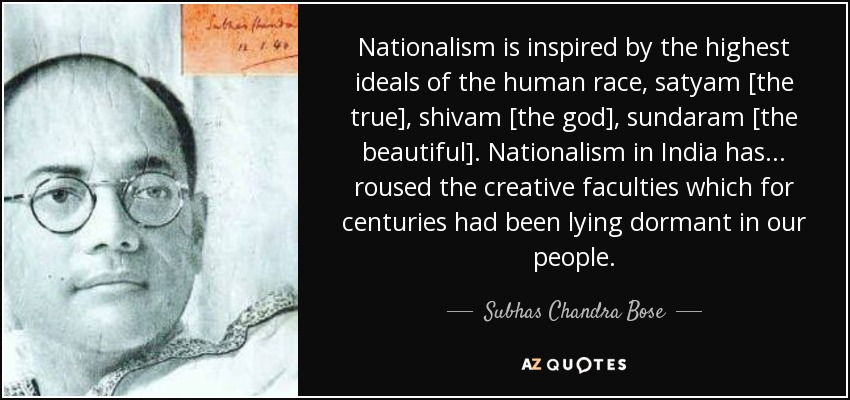
When it comes to Tagore, unquestionably, the Bengalis naturally claim to be the legal heirs of his legacy. So, not surprisingly, Sugata Bose, the grand nephew of none other than Netaji Subhas Chandra Bose, and also a present MP from the Trinamool Congress, gave a soundful speech at the Parliament on nationalism and patriotism, with lofty quotes from Tagore. Interestingly, Sugata Bose represents the constituency of Jadavpur University, which was founded during the days of the Swadeshi movement, as a college with Aurobindo (then Ghosh) as the principal.

“The nationalism that is being talked about from the other side of the House”, Sugata said in the parliament, “represents centralized despotism and it is talking about a rigidly unitarian imperial state. [Tagore] composed our national anthem but he was also a powerful critic of nationalism. Tagore knew that nationalism can be both a boon and a curse… I sometimes fear that those who are defining nationalism so narrowly will end up one day describing Rabindranath Tagore, the composer of our national anthem, as anti-national, if they read some of these sentences in his book on nationalism.”

So essentially Sugata was trying to say, quoting Tagore intelligently, that the sort of nationalism the BJP and its unitarian allies espouse, and which might have instigated them to call those bright young brains of JNU antinational, is not the true form of nationalism. Indirectly, he was also trying to say that the sort of nationalism the opposition and the likes of Girish Karnad and many other academicians, intellectuals, teachers etc. espouse is the right one.

Sugata is not the only one. A quick search in the internet will land you on many articles replete with similar thoughts that even if someone pledges to wage a war till he ensures India’s barbaadi, still his nationalism can’t be doubted.

That’s where it’s important to know what Tagore actually said. It’s not that what Tagore or Gandhi have said are sacrosanct and that anything else has to be thrown away in the garbage bin. But we can indeed get a good perspective from some thoughtful minds who have spent their whole lives to think big and good about India.

Yes, it’s true that Tagore’s idea of nationalism was not always the same as that of Gandhi’s. His novel Ghare Baire, Home and the World, depicts a classic confrontation between two schools of nationalism through the two main characters Nikhil and Sandip. Nikhil, a zamindar, is against the boycott of the English goods as he feels the poor farmers can’t afford to buy the costlier swadesi products of inferior quality. Contrary to him is Sandip, a fiery revolutionary, who doesn’t even mind resorting to violence for the sake of his country. Nikhil’s point is that nationalism at the cost of the basic standard of living of the poor farmers is unacceptable. Sandip represents the Swadeshi movement we know of.

It’s clear what Tagore wants to say by the two sides. Nikhil’s nationalism is at the grass root level, where the wellbeing of his people can’t be compromised for the sake of any lofty ideal. Sandip’s nationalism borders to arrogance, perhaps the type Sugata wanted to denounce in his speech, and the sort which he might have referred to as centralized despotism, unitarian and imperial. It’s true that nationalism often smacks of arrogance and BJP’s actions and gestures in many cases might have been arrogant. But that doesn’t mean that the young minds who want to fight till Hindustan’s barbaadi is another form of nationalism. In the context of Ghare Baire, Nikhil’s opposition to the so called swadeshi movement is by no way connected to anyone’s barbaadi. Rather, he is more concerned about his poor subjects, his zamndari. His love for his own land, his own people doesn’t allow him to get swayed away by anything.

English words like nationalism and patriotism don’t have an exact Indian counterpart. The words which come close to both are perhaps deshatmabodha and deshaprema. Deshatmavoda, when broken down, yields desha, atma and bodha. So essentially it’s the bodha or consciousness of seeing the desha, the country, as your own soul, atma. Desha-prema is simpler. It means the love for the country.

It can be argued that a person who loves his country may not necessarily always sing odes to his country. He may be very well a critic and may point out all the wrongs or evils happening in his country. Country always needs such people who point fingers to all the wrongs, so that the wrong doers can rectify themselves and help create a better country. So here too, the motive behind criticizing is an underlying love for the country.

When someone says he wants to fight till his country is finished, I wonder, is his desiring to see a better country? Even the most illogical person will realize the motive behind such a thing can’t be his love for the country. It’s the hatred that wants to “finish” something.
It can be argued what if someone doesn’t love his country, can he be hounded for his feelings? Democracy gives anyone the right to love or hate. Why can’t he hate his country? True. You can very well hate your country and shout at the top of your voice. But it can’t be then termed as nationalism. It can’t be either desh-atma-bodha or desha-prema. So going by the Indian words for nationalism or patriotism, shouting for India’s barbaadi can’t be nationalism, from any angle. And if it’s not, then the antonym for desha-prema is desha-droha. So what’s the wrong in calling those JNU students, who were shouting, “Hindustan ki badbaadi tak yeh jung”, desha-drohi, anti-national?

Whether the JNU students can be booked for treason or sedition is an altogether different thing which the judiciary has to handle. It’s not the business of the opposition or the likes of Girush Karnad and Ramachandra Guha or anyone else to comment on that, like it’s no one’s business to say that the Supreme Court was wrong in convicting Afzal Guru. You may hate the country, but rubbishing its Supreme Court is more dangerous than anything else. Such things attack the very foundation of the country and will surely cause India’s barbaadi, which is exactly what the JNU students want to fight a jung for.
Finally, let’s see if such things can be accepted as freedom of speech. Alongside the concept of freedom, which essentially means boundlessness, there’s also another aspect of freedom whose embrace is, in Tagore’s words, ‘in a thousand bonds of delight’. He says, ‘Thou ever pourest for me the fresh draught of thy wine of various colors and fragrance, filling this earthen vessel to the brim. My world will light its hundred different lamps with thy flame and place them before the altar of thy temple.’ This essentially refers to some binding that’s necessary to ‘feel the embrace of freedom’, enjoy the various diversities of the nature in the form of the hundred different lamps, the various colors and fragrance. In an essay Tagore explains you need to “bind” the strings of a sitar to “liberate” the diverse notes of music. So essentially, freedom without any restrain, binding, is as dangerous as the lack of it. It’s like a boat without an oar drifting in the middle of an ocean. In the same way, freedom of speech without any constrain and restrain is a dangerous thing.

Not everything and anything can be accepted in the name of freedom. Shouting for India’s barbaadi is not freedom of speech. It’s nonsense. It can’t be tolerated, like it can’t be tolerated if someone uses filthy and sexually explicit language in front of a woman. Going by the logic that as long as any action or speech doesn’t create any violence, you can’t book anyone for sedition or treason, outraging the modesty of a woman should have been restricted only to physical violence, which in this case would be rape. But wouldn’t it be disgusting to argue in that way? So why someone shouting for India’s barbaadi wouldn’t be disgusting, even if he’s not causing any physical harm or violence? Period.

Thursday, June 25, 2015

The International Yoga Day and the Same Clichéd Reaction from the Secular Front

“I won’t do Yoga tomorrow”, says an article in a major Indian English daily, with reference to the International Yoga Day being promoted and observed by the Indian government on 21st June, 2015. “I won’t have the government dictate my fitness choices,” it continues, “especially if they are linked to religion, nationalism and patriotism.”
Another one says, “You won't find many of my fellow yogis involved in the tamasha that is the International Day of Yoga.” It relegates the government’s efforts to something as silly as “record chasing”. It says that the “International Day of Yoga never had much to do with yoga. It was always more about the churning PR wheel of the government.”
These are just two instances. There are many such in the media and internet. Such reaction from a particular section of media and intelligentsia was well expected. By this time it has become like a pattern which doesn’t take rocket science to recognize. You could very well predict what you would expect from whom. At times it sounds like a broken record.
Debates and arguments are the pillars of a vibrant democracy. It’s always useful to hear all the voices and put forward your own too. That’s how raw concepts or ideas could crystallize into a diamond of a thought. But the problem arises when someone’s intention is not to indulge into any form of constructive or argumentative discussion, but only to vilify anything with a preconceived and prejudiced idea.
Some of the clichéd critiques of the International Yoga Day are as follows:
·         It’s another Hindutva propaganda of the BJP government
·         It’s just a media gimmick, “churning of the PR wheel of the government” and another effort to be in the news
·         It’s another divisive tactic of the government to exclude the minorities
·         Who’s the government to enforce Yoga on us? We’ve been practicing Yoga since long enough to be reminded of it like this
All of these critiques are quite amusing, rather ridiculous. Let us discuss each of these one by one.
Connecting The Yoga Day to Hindutva is a very expected reaction from the fiery band of neo-secularism (pseudo secularism??), which Mr. L K Advani, in his autobiography, rightly refers to something that “has come to mean allergy to Hinduism”. For no good reason anything that’s associated with the ancient Indian past (pre Christian and pre Islamic) is seen with suspicion by these neo-secularists. What they forget is that the civilizations and cultures in India and China predate both Christianity and Islam by many many centuries, and perhaps a few millennia too.
The various and diverse ways of lives, traditions and thoughts that evolved over many millennia in the Indian subcontinent eventually got a Hindu designation. Today whatever goes by the name of Hinduism is something that’s truly indigenous in nature. Over the years many other traditions and cultures did appear in the subcontinent from various sources, often naturally, peacefully, and often through force and coercion, all of which along with the indigenous ones finally gave the current shape and form to the Indian culture. So, trying to ignore the indigenous elements of the Indian culture just because it has the Hindu designation is like ignoring the foundations of a large edifice.
Now coming to this particular event of celebrating an ancient Indian tradition through an International Day of Yoga, let us see whether it can be really seen as something communal, belonging to a particular community, or universal, especially when Pakistan has abstained from observing it.
“By proclaiming 21 June as the International Day of Yoga,” says the United Nations “the General Assembly has recognized the holistic benefits of this timeless practice and its inherent compatibility with the principles and values of the United Nations.”
Yoga is, as stated by the United Nations, “an ancient physical, mental and spiritual practice that originated in India. The word ‘yoga’ derives from Sanskrit and means to join or to unite, symbolizing the union of body and consciousness.” International Yoga Day, it continues to say, “aims to raise awareness worldwide of the many benefits of practicing yoga.” The draft resolution establishing the International Day of Yoga was proposed by India and endorsed by a record 175 member states.
It’s indeed true that the proposal was first introduced by Prime Minister Narendra Modi in his address during the opening of the 69th session of the General Assembly, in which he said: “Yoga is an invaluable gift from our ancient tradition. Yoga embodies unity of mind and body, thought and action ... a holistic approach [that] is valuable to our health and our well-being. Yoga is not just about exercise; it is a way to discover the sense of oneness with yourself, the world and the nature.”
But just because it’s an ancient Indian tradition which predates Christianity and Islam, and which is well connected to the Hindu or Indian philosophy, does it make it communal? Or is it so because the idea was mooted by Narendra Modi, who represents BJP, which has connection to RSS, and so on?
The UN Secretary-General Ban Ki-moon himself pointed out that “Yoga is a sport that can contribute to development and peace.” The late B. K. S. Iyengar, perhaps the most famous Yoga Guru of the world said, “Yoga cultivates the ways of maintaining a balanced attitude in day-to-day life and endows skill in the performance of one’s actions.”
Even without going into what’s said about Yoga in the ancient Sanskrit texts and what it exactly means in the context of Indian philosophy, there’s no doubt that it’s nothing that should be viewed with suspicion by any community.
The same may hold true for Surya Namashkar or the Gayartri Mantra, none of which has anything that could be communally charged or divisive. The later says, “We meditate on the power and glory of Him, the Creator, the Savitri, who sharpens our thoughts.” All religions and cultures, Christianity and Islam included, look upon the Creator of the Universe with utmost reverence and pay obeisance to Him. The Creator is often seen as the Supreme God Himself. May not be in the exact same language, but a similar reverence for the Creator is found in the Prophet Muhammed’s own words too. The 30th hymn of the 21st chapter of the Quran says, “Awalam yara alladhin kafaru, don't see those who disbelieved, anna al-samawati wal-arda kanata ratqan, that the heavens and the earth, were a joined entity. Fafataqnahuma, then We parted them…”
So what’s the issue if a government wants to invoke the Gayatri Matra at the beginning of a function? It could be argued that similar hymns from the Quran or the Bible could also be invoked. But then those were not written in India and the Gayatri Mantra was. Doesn’t that make it more relevant to be used in India? It doesn’t harm if any country adopted a poem, written by someone not belonging to that country, as its national anthem. But it does make more sense to use a poem written in its own land, by its own countryman. Would you call it a communal act? No. In the same way, invoking a Sanskrit poem with a universal message or celebrating an ancient Indian secular tradition like the Yoga can’t be a communal act. It’s in no way a divisive tactic to frighten the minorities.
Interestingly, the present day Iran with its predominantly Muslim population still celebrates the Nowruz, the Persian New Year, which is an ancient pre Islamic tradition connected to its Zoroastrian past. Though they have persecuted all the Parsis, the Zoroastrians, but they have retained the ancient traditions of the land. The same holds true for Indonesia and Malaysia, both of which are now Islamic states that have retained many indigenous practices and traditions which date back to their pre-Islamic past. Ironically, India is not a Muslim country, but still its pre-Islamic traditions are looked upon with suspicion.
Let’s move on to the next point. It’s said that this entire thing about the International Yoga Day is just a media gimmick, the churning of the “PR wheel of the government, and its desire to assert itself on the global stage, assuaging anxieties about being left behind.”
Is there any problem to assert India on the global stage? Yes, India has been left behind in many aspects and it’s the duty of its government and the Prime Minister to keep no stone unturned to assert itself in the global stage in all possible ways. It’s all about PR – even an ass knows this in today’s context. That the US is a super power, much of it is because of the perception that it has created in the minds of the rest of the world over the past hundred years through a very effective PR. Apart from doing everything correct, it’s PR which plays a big role in asserting India the right position it deserves in the world. What’s the problem here? Yoga sells and it’s Indian. So why not claim the ownership to something “Made in India”?
Foreign Minister Sushma Swaraj has rightly said that “Yoga is the soft power of India and through that soft power the whole world can be a global village.” This comment of hers has also been taunted by many. But in reality what she said is a historical truth.
In the context of India’s influence over the rest of the world William Dalrymple, in an article, quoted the historian Michael Wood as saying, “history is full of Empires of the Sword, but India alone created an Empire of the Spirit.” What he refers to here is indeed India’s soft power with which it had established its influence over a large part of the world over many centuries. Talking about the process by which this happened, Dalrymple says, “it appears… that large numbers of highly educated monks and Brahmins traveled with the fleets of Indian merchant ships trading with Indo-China, carrying portable religious objects and artworks. They sought employment and offered in return their literacy… as well as their political, technical, and cultural knowledge.”
Dalrymple mentions that according to Sanskritist Sheldon Pollock, “in the first millennium it makes hardly more sense to distinguish between South and Southeast Asia than between north India and south India…. Everywhere similar processes of cosmopolitan transculturation were under way.” Pollock describes this cultural commonwealth as the “Sanskrit cosmopolis.”
It was indeed through India’s soft power that it had asserted its influence over Central Asia, China, Burma, Indonesia, Thailand, Cambodia, Laos and Vietnam. “These were conscious acts by which the living landscape [of these countries] was empowered with mythological Indic names and Indic metaphors of divinity, in effect extending the sacred landscape of the Indian holy land so that it became their own.” The best testimonial of India’s soft power is what Hiuen Tsang said. “People of distant places with diverse customs,” wrote the Chinese Buddhist monk in the mid-seventh century, “generally designate the land that they admire as India.”
So, it’s nothing wrong in exploiting India’s soft power to assert its position in the world. It has yielded rich dividends in the past and there’s no reason to believe that it won’t now.

Finally, it’s being questioned who the government is to dictate what I should do on a particular day. This is perhaps the most ridiculous of the arguments. West Bengal government celebrates the birthday of Rabindranath Tagore through cultural functions and other events all throughout the 25th of Baisakh, the birthday day of the poet as per the Indian calendar. So does it mean that I won’t listen to Rabindra Sangeet on that day just because the government is making me to listen to it? Remembering something or someone on a particular day neither means that we shouldn’t do it the rest of the year nor that we’re being coerced to do so only on that day. Celebrating Christmas doesn’t mean we shouldn’t think about Jesus the rest of the year or that we are being coerced to think about Him on a particular day. If you have been doing Yoga for a long time that doesn’t mean that you can’t celebrate one particular day as the Yoga Day. I don’t see any problem there too.

Saturday, May 9, 2015

Alternate Hinduism or Hinduphobia? An Analysis of “Rearming Hinduism” by Vamsee Juluri


Recently an angry mob broke into a jail in Nagaland and lynched an alleged rapist to death. The mob was predominantly Christian and the alleged rapist a Muslim. The American media, points out Vamsee Juluri, the author of the recent book “Rearming Hinduism”, reported this as a law and order problem, not as a case of Christians attacking a Muslim.
Around the same time a septuagenarian nun was gang raped within the premise of a convent school in a place near Calcutta and few months before this, few churches were burgled in Delhi. Both the incidents were widely reported in India and the west as rising cases of intolerance towards minorities in a Hindu majority India. In the ghastly case of the gang rape of the Christian nun, the police would soon find the involvement of few Muslims from Bangladesh and burglaries in the churches in Delhi were found to be acts by miscreants. None was an act of violence against Christians, perpetuated, as was claimed, by intolerant Hindus.
A thought can’t but arise in the mind that perhaps, very consciously, an aura of Hinduphobia is being created. The aforementioned incidents and the way they were perceived by the world only reinforce this thought.
It is in this context that the book “Rearming Hinduism” is very relevant. The author first defines the premise of Hinduphobia as something being created and perpetuated in the Western academia and media which even went to the extent of relegating the 26/11 massacre by Pakistani terrorists as the outcome of India’s policy on Kashmir, the rise of “Hindu extremism”, and the appalling state of poverty among the Muslims in India. The misconception about the Indians (or should we say Hindus?) is not restricted only to contemporary affairs. The western academia is replete with works, Juluri points out, of the likes of Wendy Doniger who likens the ancient Hindus to the cowboys who destroyed the Native Americans and even to the Nazis who persecuted the Jews during the World War II. The New York Times, Juluri mentions, have published several articles on and by Doniger, who characterizes herself as a lover of Hinduism and her critics as “nasty, militant, prudish fundamentalists”.
The very name of Doniger’s book – The Hindus, An Alternative History – is perhaps meant to say on the face that hers or theirs “alternative history” is the real one, and that the “dominant” one of the Hindus is nothing but nasty, militant, prudish fundamental.
“There is at the moment,” asserts Juluri, “a very much powerful, sustained, and unrelenting cultural and intellectual attack on Hinduism in the media and academy”. His book “Rearming Hinduism” symbolically uses in its cover the image of the Narasimha, an iconic statue at the world heritage site of Hampi in Karnataka depicting a figure of a half man and half lion trying to write something even though one of his hands is cut, to stress on the need of the academic Hindus, “not prudes, not militants”, to write their true history to counter the flawed and misinterpreted “alternative” history.
While talking about the ideologies of Hinduphobia in the first part of the book, Juluri shows how the mainstream academia has “lost sight of Hinduism”, relying on “particular set of ideas, assumptions, and stereotypes”. He uses Doniger extensively, perhaps as a glorified representative of all the similar works – the alternative history – by western academics which, in the book stores, Juluri claims, occupy almost the whole shelves designated for Hinduism of Eastern Religions, any work of Indian author conspicuous by its almost total absence. He taunts at the hypocrisy of Doniger et al in creating an aura of phobia against the “dominant” history, allegedly purported by the Hindu writers who are always “fundamentalist” and “militant” in her views, however academic they may be.
Juluri brings out a very interesting point that what is actually being mooted as the “dominant” all-pervading view, which needs to be controlled or checked, around which all the Hinduphobia is being created and propagated relentlessly, has effectively become a very marginal view, totally overshadowed by the “alternative” views of the likes of Doniger, who rants about the Nazi like violence of the Aryans and the excessive animal sacrifices of the Hindus till the Buddha appeared in the scene to save the humanity, who extols the influence of the Greeks in the development of the fierce and independent character of Draupadi in the Mahabharata and who sees the Mughal age as an age of dialogue and tolerance.
In the second part Juluri talks about the Vedas and Upanishads, Krishna and Rama, Gita, from a Hindu viewpoint, in contrast to the main stream, heavily published and often flawed “alternative” views.
“Rearming Hinduism” is indeed a very apt book, to counter the many misinterpretations of the Indian culture and the stereotypes and clichés about it prevalent in the academia and media, not necessarily restricted only to the west. The Hindus themselves, perhaps like the image of Narasimha with a severed arm, find it difficult to understand their own culture and legacy, and write their real history, falling prey to “alternative” views.
There are a few things though which, if were handled in a better way in the book, could have had a greater impact on the very people for whom it’s written – the non-fundamentalist, non-militant and academic Hindus, “the entire generation of young modern Hindus in India and the diaspora” who is perhaps showing more and more interest in India’s heritage and the Indian identity.
The excessive criticism, not only of Doniger, but also of the likes of Amartya Sen and anyone else who espouses any view different from that of the author with regards to Indian history or culture, may not be palatable to everyone. At some point, it may appear to the reader that the book is more of a critique of Doniger than anything else.
The author touches base on many issues and myths but doesn’t put forward a proper scientific or historic analysis to debunk or accept a theory. He conveniently accepts the Out-of-India origin of the Aryans, attacking anyone who disagrees, but doesn’t provide any historical basis of his claim. The reality is that, the Out-of-India theory, or for that matter anything else about the origin of the Aryans, can neither be proved nor disproved scientifically, given the paucity of historical or archaeological evidences, but disciplines like Comparative Linguistics and Linguistic Palaeontology do point to an Outside-of-India homeland or Urheimat of the Indo-European languages and their native speakers. Ignoring the volumes of research by some of the most eminent linguists over the past one century and more, just because the findings don’t align with what the “dominant” narrative about Hinduism would fit into, weakens the very stand taken by the author all throughout the book – that any narrative, alternative or dominant, should be based on true academic quest, and not any hegemonic zeal.
Juluri criticizes Doniger for her chapter on “Sacrifice in the Vedas”, but doesn’t go at all into the counter interpretations of the very verses Doniger quotes to make her point. A cursory glance at the Rig Veda, as pointed out by Sri Aurobindo, may lead to the apparent belief that the hymns are desperate pleadings of a bunch of helpless people seeking divine intervention in almost everything. The invokers of the hymns seem to be lazy guys who want to win every battle with the help of the Gods. It also appears that the people of the Rig Veda have nothing else to do than to fight among themselves and also with the natives, who in most cases are demoted to the ranks of demons.
But a close look into the hymns reveal something more profound which’s hidden under the garb of simplistic physical, natural or historical things like fights, rivers, days and nights, mountains, clouds, floods, cows and, not to forget, horses and chariots. Going by Aurobindo's interpretation, each of these physical and natural things very logically point to deeper meanings which very consistently flow all along the Rig Veda. If we go by the literal meaning of all the words, then this continuity of thoughts is broken at various places. In other words the Rig Veda is full of double meanings. The simplistic meanings are meant for the normal people and the profound meanings for the learned. It’s obvious that Doniger took the simplistic meanings. But an in-depth analysis of the same verses by Juluri would have been much more effective in countering Doniger.
In this context it would be relevant to refer to something Doniger has mentioned in her book which Juluri criticizes all along. With reference to killing animals and plants for food, she quotes from Jaiminiya Brahmana that the “people who lack true knowledge and offer no oblations cut down trees for firewood, or cook for themselves animals that cry out, or cook for themselves rice and barley, which scream soundlessly”. Here she makes a very interesting observation that the reference to rice and barley as something “which scream soundlessly”, when killed and eaten, is almost like paraphrasing the words of the eminent Indian scientist Jagadish Chandra Bose, who “moved George Bernard Shaw deeply with his demonstration of an unfortunate carrot strapped to the table of an unlicensed vivisector.” Bose believed, very much like what the Jaiminiya Brahmana too might have hinted, that plants too can feel pains and emotions, like animals.
If such views are to be countered, it needs an equally in-depth counter analysis of the ancient Sanskrit texts, something which could have made Juluri’s views stronger.
The author finds Amartya Sen’s highlighting of the reigns of Ashoka and Akbar as golden epochs in the annals of Indian civilization objectionable just because neither of them were followers of Hinduism – Ashoka converted to Buddhism and Akbar was a Mulsim. Such a ground for attacking Sen appears clichéd and reactionary, something which Juluri himself accuses the secularists and the orientalists like Doniger and Sen of being.

Another thing which can perhaps create some confusion in the minds of a wider range of readers is Juluri’s reference to May 2014 as some sort of a reckoning of a new epoch in the Hindu history. Though he never takes the name of Narendra Modi, but the indirect references to his becoming the PM and the BJP coming to power in May 2014 leave no suspicion in the minds of the readers about the significance of May 2014. This is somewhat irrelevant and out of context to the main intent of the book, which is actually establishing the real and “dominant” narrative of Hinduism against the so called mainstream, and often flawed, Hinduphobic orientalist one.